Saturday, 30 April 2011

Identity in a digital age

Much of my understanding of digital identity was founded in my studies into personal identity, whilst a student of social psychology. The work of William James and George Herbert Mead influenced my thinking, as did the study of sociologist Charles Cooley into 'the Looking Glass Self.' Essentially, in this hybrid early school of social psychology, known as symbolic interactionism, theorists tried to explain the influence of audiences/other people on the behaviour of individuals. It was a fluid theory that allowed for behavioural adjustments on the fly, as people saw themselves 'reflected in the eyes of the other' - the impact of what they were saying - as they conversed. Therefore, 'in order to develop and shape behavior, interactions with others must exist. People gain their identity and form their habits by looking at themselves through the perception of society and other people they interact with.' (New World Encyclopedia)

I did some research of my own back in the 90s based on the presentation of self in everyday life. Those who are familiar with the work of the social anthropologist Erving Goffman will recognise this as the title of one of his seminal works. Goffman saw social interaction as a drama performance, in which the actor's behaviour was framed by front stage and back stage roles, scripts, props and costumes. One of the most important, but often ignored features of Goffman's Dramaturgical Model is the presence of an audience, to which the actor consciously (or unconsciously) performs. This has great import in our understanding of how we perform to audiences in social media (of which more later in this post).

The research I conducted in 1994 involved a small team of psychology students and one of my friends, the actor and TV personality Matthew Kelly. Now a successful actor of stage and film, during the 1990s Matthew appeared on everyone's TV screens several times a week and was instantly recognisable. He was ideal for the study and when invited, he agreed to take part. We wanted to test out our ideas on the 'celebrity effect' in which people change their behaviour when they meet face to face with a famous person. In today's celebrity soaked society, where in Andy Warhol's terms 'anyone can be famous for 15 minutes', we are perhaps living in what Malcolm MacLaren dubbed 'the Karoake culture.' This means that just about anywhere, at any time, without warning, anyone can bump into a celebrity - there are enough of them about. Although it's possible, it's not probable, but there are occasions when this happens with no warning and no preparation, and you find yourself looking at a well known face. In such situations, people behave differently. They stare. Or they deliberately avoid staring. Either way, they know that they are sharing a space with a famous person, and can't help behaving differently. I was intrigued as to why this should be.

So we set up and conducted a naturalistic series of experiments in the high street of an English City. We wanted to know if, as Isen and Levin (1972) predicted, people would be more likely to help others if they felt good themselves. There was also research to suggest that helping behaviour increased depending on the status and influence of those present (Latane & Harkins, 1976). My study went something like this: In the experimental condition, two of us walked into a shop and posed as customers. A minute later, one of our team, an unknown person, walked into the shop accompanied by Matthew Kelly, and made straight for the counter. The unknown person showed the shop assistant a £10 note and asked if s/he could help by giving him some change from the till so he could make an urgent call home (this was in the days before mobile phones). We observed the interactions and timed the conversation. In a control condition, we also performed the same situation where two unknown people walked into similar matched stores and acted out the same scene. This same scenario was acted out 11 times for each of the conditions. We analysed the data from the 22 shops and saw immediately that there was a marked difference between the experimental (famous) and control (unknown) conditions.

In the control condition, our team was refused help (told they could not have change unless they purchased something) on 6 out of 11 occasions, and minimal interaction was observed between the unknown people and the shop assistant. In the experimental condition, on every occasion, the famous person and his partner were helped. If the shop assistants couldn't open the till, they found the change from their own pockets/purses or those of their colleagues'. Another interesting effect was that on each occasion, although the only speaking person was the unknown person, the shop assistants were observed answering Matthew Kelly, and maintained eye contact with him rather than the speaker. The unknown person was virtually ignored, even though he had initiated the conversation and was doing all the talking. Non verbal interactions such as smiling and nodding were also more numerous in the experimental condition than in the control condition, where minimal or no eye contact was observed between the shop assistant and the two unknown people.

From these statistically significant results (p<.005), I theorised that (in Goffman's terms) shop assistants who were in their rule bound front stage roles (e.g. I must not open my till to give change unless someone has made a purchase, because the note may be a forgery), were forced into back stage (relaxed and informal) roles prompted by a pleasant surprise. They broke their own rules, because they recognised the famous person (someone who perhaps they had seen often in their back stage informal roles in their own living rooms) and behaved in a way that was incompatible with the rules they would follow in their front stage, official and formal roles.

In my conclusions I noted: "The celebrity effect has obvious consequences for the promotion of pro-social behaviour. Front stage roles (rules) are subjugated by the desire of the actor (shop assistant) to appear helpful and pleasant to the well-known person. However, this helping behaviour occurs at the expense of anyone else who happens to be nearby. Attention is focused on the famous person, while the requests from others, although not ignored, become marginalised".

Applying this research in today's digital world, I wonder what the presentation of self in a social media world would entail. Applying Goffman's theory to the performance spaces of social media, we could cast a spotlight on videosharing services such as Youtube and text based performace spaces such as traditional blogs. Do bloggers see themselves as interacting with their audiences in a front stage context? If they do, then they will possibly be more guarded and less personable, avoiding as much self-disclosure as they can? On the other hand, if bloggers see themselves as performing in a less formal space, in a more relaxed style, are they then back-stage? Do they then feel licensed to self-disclose more personal information about themselves, or share their emotions, their beliefs? Perhaps the questions should be framed the other way around? Does self disclosure and informal sharing of personal information push bloggers into a back stage role, and what is it that enables some to do this? Is it the pleasant experience of having a large appreciative audience? One more question springs to mind - are bloggers who disclose information about themselves of a personal nature more readable (and more personable) than those who write whilst remaining in a front stage, formal role? These and other related research questions are of course, up for grabs for someone to investigate.

References

Cooley, C. H. (1918) Social Process. New York: Charles Scribner's Sons.

Goffman, E. (1959) The presentation of self in everyday life. New York: Anchor Books.

Isen, A. M. and Levin, P. F. (1972) Effects of feeling good on helping: Cookies and kindness. Journal of Personality and Social Psychology, 21(3), 381-8.

Latane, B. and Harkins, S. G. (1976) A multiplicative power function of audience size and status. In R. L. Atkinson, R. C. Atkinson, Smith, E. E., Bem, D. J. and Hilgard, E. R. (1990) Introduction to Psychology, 10th Edition. San Fransciso, CA: Harcourt Brace Jovanovich.

Image source by Ocadotony

Creative Commons Licence
Identity in a digital age by Steve Wheeler is licensed under a Creative Commons Attribution-NonCommercial-ShareAlike 3.0 Unported License.

Wednesday, 27 April 2011

...before the ink is dry

Had a great conversation at lunch today with Peps McCrea over at the University of Brighton. We were talking about our common interest in the educational benefits of blogging, and I made a suggestion that digital identity was a significant factor in the way teachers and other professionals use it (I will blog on this idea in a future post). I expanded by talking about my own use of blogging. I had to examine my own motives which I have already reflected on in previous posts such as Why do I bother? So what are my reasons for expending so much of my time on blogging?

Essentially, I blog not just because I want my ideas to be shared as quickly as possible, but also to receive feedback in the form of discussion. Journal articles take so long to publish, they are often out of date long before the ink is dry. This is because they go through a process of peer review and revision, and then they can hit a brickwall if the journal has a significant backlog of accepted papers, and a page count limit (which most do). I know that peer reviewed academic journals are the lifeblood of the Research Excellence Framework (REF) which comes around every few years (and by which all participating universities are judged on the quality of their research outputs, and subsequently awarded money for more research). I know that great store is placed on high impact journals in th REF and there is always a mad scramble at this time in the cycle, where everyone is submitting articles in the hope they will be published before the deadline. But how much value is there really to be had in publishing articles in high impact, double blind, peer reviewed academic journals beyond the REF? You have to be in it to win it, but the general rule of thumb is that the best research institutes scoop up the lion's share of the cash each time, and the rest are left to grab for the crumbs. An enormous amount of energy and time is taken up during the submission process, often with little or no reward to show at the end.

Here's something else to consider: How many people actually read your journal article when it's finally published, either in paper format or on the journal's webpages? The journals we are talking about here are almost all paywall journals - if your institution doesn't have a subscription and you are not in the mega-rich academic club (and let's face it, who is?) then you are unlikely to be able to read it, and neither are many others. Will publishing in a high impact journal ensure that you are promoted? Possibly, but not probably, as many academics have discovered. How about some monetary reward? Not a hope of that, sunshine - the publishers have tied that one up at both ends. In some business models, they even get you to pay for the priviledge of publishing in their journal. Nice trick if you can do it. If I was to be cynical, I might suggest that the publishing houses have conspired to convince academics that they should spend inordinate amounts of their time dreaming up research ideas, running their experiments and studies, and sweating and toiling over the write up of the research, before giving it away for free so that the publisher can then make a lot of money out of it.

For me, and for an increasing number of fellow academics, publishing in traditional journals is becoming increasingly anacronistic in the digital age of social media communication. We can be our own publishers now. We can build up audiences and loyal followings that are larger than most journals and publishing houses could ever boast. For me, blogging is now the first place I consider when I want to disseminate my ideas quickly, directly to my own community of practice, and in a form that is considered relevant and accessible to those who are engaged in that particular sphere of activity. Blogging is freely accessible, and it is usually concise enough to be assimilated in a few minutes.

Please don't misundertand me - I am not totally dismissing the place of the academic peer reviewed journal. Heavens, I'm an editor of a major learning technology journal, and if I believed they were totally irrelevant, I would resign immediately. No, journals still have their place. What I am arguing here is that the blog is a more rapid, concise and appropriate medium to disseminate important ideas, and it is also a better environment within which to engage critically with colleagues to discuss, argue and otherwise develop a discourse around the subjects in question. I have seen some journals attempting dialogue between protagonists occasionally, but often the result is a stilted, and seemingly contrived dialogue which is somewhat divorced from real-time, real-world conversations. How is the blog different? For me, the blog is an interactive record of ideas; an open archive of opposing viewpoints; a meeting place for live discussion; a repository of thoughts; a testing ground; a launching pad; a dynamic environment within which disagreement can sit comfortably with accord; a fertile ground for the planting and growing of disparate content.

Image source by Hakan Dahlstrom

Creative Commons Licence
...before the ink is dry by Steve Wheeler is licensed under a Creative Commons Attribution-NonCommercial-ShareAlike 3.0 Unported License.

Tuesday, 26 April 2011

Best years of our lives?

They say that our school years are the best years of our lives. But for many children, that is untrue. About a year ago, I wrote a personal account of an incident during my primary schooling that shaped my young adulthood. In That'll teach him, I recounted an incident where I asked a question in class, and the teacher ridiculed me. It was a bad experience. Being laughed at by the whole class on the teacher's instigation was humiliating, embarrassing and also a very powerful negative influence on me. I learnt never to ask questions in school again. It took me a long time to shake off that stigma and be bold enough to ask questions again. And it was important for me, because we learn by asking questions. Teachers have such power and influence over their young charges, and many are largely unaware of it. It's true that doctors save lives, but teachers make lives. That post served to illustrate some of the bad practices some my teachers adopted, and said a lot more about that particular teacher than it did about me. From that bad experience, eventually, came some very positive outcomes. But what about my positive experiences in education? Well, there have also been some very inspirational teachers...

The teachers who have inspired me most are those who have been accessible not remote, personable instead of standoffish, and knowledgeable without being arrogant. One of my lecturers in my first year of my undergraduate degree (he is now a well respected colleague of mine in the Faculty of Education) inspired me to learn more and to push myself to my limits to become more knowledgeable in my subject area. He did this through the use of nothing more than a whiteboard and pen, and constant discussion and questioning. This kind of simple socratic discourse was deceptively powerful, and did wonders for both my self esteem and piqued my appetite for more knowledge. He didn't need to use any other visual aids or learning resources. He simply pointed us in the direction of useful reading, and strategically slipped the names of key theorists into his discussions with us. For me this was a skillful, but relaxed and unobtrusive kind of pedagogy, involving everyone in the room, debating, deliberating and generally exploring together the nuances and intricacies of our subject. There was no lecturing, and there were no absolutes. Just the inspiration of the discussion and the joy of knowing that you were going to leave the classroom with more questions than when you came in.

Who were your inspirational teachers?

Image source

Creative Commons Licence
Best years of our lives? by Steve Wheeler is licensed under a Creative Commons Attribution-NonCommercial-ShareAlike 3.0 Unported License.

Wednesday, 20 April 2011

Smartphones in mobile healthcare

I have just had a new paper published on how smartphones are being used in patient education and remote health care. The paper appears here in Biomedical Engineering Online and is entitled How smartphones are changing the face of mobile and participatory healthcare. I see it has already been labelled as 'Highly Accessed' which bodes well, and of course, it is published as an open access article complete with downloadable pdf file. Written in collaboration with my colleagues in the Faculty of Health at the University of Plymouth, the paper covers a range of telehealth issues as detailed in the abstract:

The latest generation of smartphones are increasingly viewed as handheld computers rather than as phones, due to their powerful on-board computing capability, capacious memories, large screens and open operating systems that encourage application development. This paper provides a brief state-of-the-art overview of health and healthcare smartphone apps (applications) on the market today, including emerging trends and market uptake. Platforms available today include Android, Apple iOS, RIM BlackBerry, Symbian, and Windows (Windows Mobile 6.x and the emerging Windows Phone 7 platform). The paper covers apps targeting both laypersons/patients and healthcare professionals in various scenarios, e.g., health, fitness and lifestyle education and management apps; ambient assisted living apps; continuing professional education tools; and apps for public health surveillance. Among the surveyed apps are those assisting in chronic disease management, whether as standalone apps or part of a BAN (Body Area Network) and remote server configuration. We describe in detail the development of a smartphone app within eCAALYX (Enhanced Complete Ambient Assisted Living Experiment, 2009-2012), an EU-funded project for older people with multiple chronic conditions. The eCAALYX Android smartphone app receives input from a BAN (a patient-wearable smart garment with wireless health sensors) and the GPS (Global Positioning System) location sensor in the smartphone, and communicates over the Internet with a remote server accessible by healthcare professionals who are in charge of the remote monitoring and management of the older patient with multiple chronic conditions. Finally, we briefly discuss barriers to adoption of health and healthcare smartphone apps (e.g., cost, network bandwidth and battery power efficiency, usability, privacy issues, etc.), as well as some workarounds to mitigate those barriers.

Image source by C Frank Starmer


Creative Commons Licence
Smartphones in mobile healthcare by Steve Wheeler is licensed under a Creative Commons Attribution-NonCommercial-ShareAlike 3.0 Unported License.
Tuesday, 19 April 2011

New blends in learning

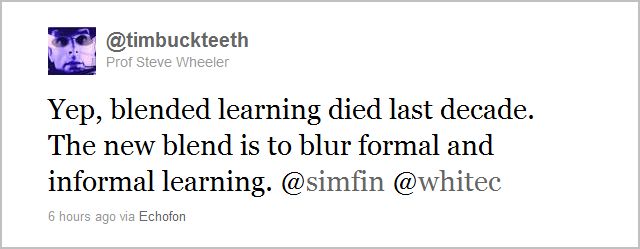
I started a discussion on Twitter today about blended learning, after reading an exchange between @simfin and @whitec. Unfortunately, the limit of 140 characters, on this occasion at least, badly let me down. Now look, just like any other academic, I don't mind a bit of a verbal punch-up, in fact I relish it. If you want an argument, I'll give you one, and just when you think it's all over, I'll come back for some more. But what I don't enjoy under any circumstances being misunderstood. Today's discussion about blended learning on Twitter was for me at least, somewhat unsatisfactory. I was away for some of the time, engaged in editorial work, and as I wasn't able to make my point clearly, I didn't persist. But, knowing me like you do, you know it's not over. So I'm using this blog to elaborate on my ideas in the hope that a more informed discussion can ensue and that this time I will not be misunderstood. Here's what I originally tweeted:


By this statement I meant this: Blended learning (in the established, traditional sense) means a mix of learning activities that involved students learning both in the classroom, and at a distance from the classroom, usually mediated through technology. I am claiming that this type of blended learning - in concept at least - is now outmoded because the boundaries between local and remote have now been substantially blurred. The tyranny of distance has been fractured. My students now learn across a continuum that encompasses the classroom, home and all points in between, any time, any place. They use the same or similar technologies in the classroom as they do at home, as they do on the bus, as they do... you get the idea. Geography (location of study) matters less and less as technology becomes more familiar, transparent and affordable, and students are connected with their peers, tutors and content in continually new and dynamic ways. This is why blended learning, in the old traditional sense is now a fairly meaningless term.


The second part of my statement was more contentious to those who responded to my tweet. I said that the 'new blend is to blur formal and informal learning.' This provoked a storm of responses. Someone said that the idea of formal/informal learning wasn't 'new'. Let me clarify - by 'new' I meant it's a new challenge for teachers. It means they may have to consider replacing some of their practices and it means that schools may need to revise some of their rules. Let me explain again:
Young people now bring so much informal technology into the classroom (mobile phones, handheld games consoles, etc), which they use constantly outside the formal boundaries of formal learning. Without really thinking about it, they use these tools to create and share content, connect, communicate and collaborate for their informal learning. Presently many schools simply ask their students to 'turn off' the devices when they arrive in school, because there are concerns about innappropriate use (cheating, bullying, recording and posting images or videos, etc). One challenge for school leaders today is to balance the risks against the benefits and decide what role if any these informal tools have in a formal context. The major challenge for educators then is to decide whether they wish to harness the power, excitement and allure of these informal technologies with a formal context.

A point was made by Anne-Marie Cunningham that the formal and informal have always been naturally blended by students, and it's nothing new, and to a great extent this is true. However, there is something new we need to consider. With the advent of emerging digital technologies, there are now more opportunities than ever to exploit the potential blend between formal and informal learning. To simply say that it's not new, has always been there, and therefore we don't need to be concerned with it, is ignoring the incredible potential we now have within our grasp to enrich, enhance and extend student experiences.

Mike John implied that because there is only learning and teaching (of which of course I agree) we shouldn't be labelling it with other terminology, because in doing so, we are 'taking our eye off the ball.' I know what he's getting at - the learner should be central - but I counter this by pointing out that if you are discussing the pedagogical theories behind the multitude of different practices observed in the classrom every day (my stock-in-trade) you need different words to engage fully and effectively in the discourse. Differentiating these practices necessitates giving them terms that describe, define and delineate them from each other. Yes, in the final analysis there is only learning and teaching, but we are not taking our eye off the ball in this discussion, we are merely finding out how many ways there are of kicking the ball. Education would be poorer without variety.

Finally, I want to make the point that blended learning in the new sense will also see the boundaries between teacher and learner blurring. I believe the two are a part of a continuum, because we learn by teaching. Sure, the teacher will be paid to develop and facilitate learning processes, but they will accompany students rather than leading them, and students in turn will surely teach each other more. We know that one of the most powerful and persistently positive learning outcomes in all sectors of education arises when reciprocal teaching is employed - the metastudies of John Hattie have established this across multiple contexts. So my prediction is that learning and teaching as activities will blend too. So there you have it. Blended learning as a concept is outmoded, and the new challenge for educators is to bring the excitement and affordances of informal technologies into the formal context. Other boundaries will blur as teaching and learning begin to coalesce. I hope I have been clear, and I'm quite happy to debate this further. Am I right or am I wrong? You tell me.


Creative Commons Licence
New blends in learning by Steve Wheeler is licensed under a Creative Commons Attribution-NonCommercial-ShareAlike 3.0 Unported License.

Monday, 18 April 2011

Running a MOOC

Over at the University of Brighton, Peps McCrea is currently blogging about MOOCs (Massively Online Open Courses) and is speculating how they might influence the future of Higher Education. Having taken part in a MOOC run by Stephen Downes and George Siemens a couple of years ago (as a speaker not a student), I can say that it was a very enjoyable experience. I was grilled by Stephen for a sustained period of time about my ideas on Personal Learning Environments, and in true gladiator style, I enjoyed the cut and thrust of my live, widely distributed debate.

I have also presented recently at one of Steve Hargardon's live Elluminate global webinars, and have to say that the experience was very similar to the MOOC. You present your ideas, including slides and audio connection, live to a massive group of participants that span the globe, and then you discuss those ideas for a while. I know that there is more to a MOOC than participating in live webinars. MOOCs also host online discussion, solo and group activities and other learning activities designed to promote critical discourse, reflective actions and discursive learning.

Everyone who participates enjoys the experience, and everyone goes away with more questions than they arrived with. That's learning. That's connectivism too, according to Siemens and Downes. And connectivism is one of the major underpinning theories of the MOOC. It's not so much what you know that matters anymore, but who you can connect to and learn from that is the key principle of learning in a digital age.

That is both the strength and the weakness of the MOOC. You see, you can connect to anyone, anywhere, at any time to learn from each other. But you can also miss those connections, if certain people decline to join in. MOOCs are also at their most successful when there is a critical mass of participants. So what if you gave a party and no-one came? A sparsely populated MOOC is just .... well..... an OOC, isn't it? There is also a debate about whether connectivism is actually a bona fide theory - it has attracted its fair share of critics. Peps is asking whether MOOCs will take off in the UK. Well, in one sense they already have because many people from the UK have already taken part in previous MOOCs. If it comes down to the location of the MOOC, there is none - the MOOC is location agnostic. I actually presented my MOOC talk from a classroom in the Cork Institute of Technology in Ireland. If the question relates to whether British academics and specialists will begin to write, organise and deliver MOOCs, that's another question entirely. Here are some more questions: Is there actually a need for more MOOCs? How much preparation work goes into setting one up? Will individuals in the UK step in to set up and deliver their own MOOCs, or is this going to be the preserve of academic institutions? The question of open, free of cost participation in a MOOC is a given. But what about those who wish to receive some tangible form of accreditation at the end of the programme? Who provides that?

Good luck to anyone who decides to set up and deliver a MOOC this side of the Atlantic. And as to the future of the MOOC? I suppose we shall just have to wait and see...

Image source by SpoiltCat

Sunday, 17 April 2011

The road is open

In spite of the trials and tribulations of international travel, I actually had a wonderful time in Elmshorn, Germany this week during the two day Moodlemoot event. I met a lot of smart people, and engaged in some very valuable conversations about learning, technology, culture and life in general. The Sounds of the Bazaar Internet radio guys were also present and I managed to squeeze in a live interview on Day 1 with Klaus Rummler on the 'future of learning', as we stood outside in the spring sunshine. My opening keynote focused on openness in education, and I made a call for more open scholarship and open educational practices. Because I was 'preaching to the converted' (the audience was made up of around 300 teachers and other professionals who were already sold on the idea of using open source tools such as Moodle and Mahara in their work), my presentation was very well received, and there were some excellent, thoughtful questions at the end. My slides are here.

It was also a great pleasure to hear two other keynote speakers, Martin Dougiamas, Moodle's founder, who spoke live via Skype from Perth in Australia, and Max Woodtli, a Swiss academic who spoke on 'Visible Learning' - highlighting the work of New Zealand academic John Hattie. Although Dougiamas's presentation was marred by technical difficulties, he was nevertheless able to make his point, via a series of technical illustrations, including the announcement that a set of new mobile phone apps for Moodle will be released in the coming weeks. Max Woodtli was more pedagogical in his focus, talking about the most effective approaches to securing good learning outcomes. Although he spoke in German, I had the excellent services of Stephan Rinke, translating simultaneously for me. Woodtli showed how through a vast range of metastudies ranging from primary to tertiary education research, distance education and online web based methods have no more impact than traditional teaching, and in some cases have poorer outcomes. It is only when teachers forge strong working relationships with their students, and promote the use of methods such as concept mapping, reciprocal teaching and other active forms of problem based learning, that learning outcomes are strong and long lasting. How we transfer those methods effectively into digital learning environments will determine the future of learning platforms such as Moodle, he said.

My thanks go to all who organised Moodlemoot, and in particular, Sigi Jakob-Kühn, who invited me to speak at such an enjoyable event.

Image source by Stephan Rinke