Showing posts with label digital technology. Show all posts

Monday, 12 November 2012

The future of gaming

Games based learning is one of the most important strategies for 21st Century education. We have enjoyed playing games since time immemorial, and video arcade games such as Asteroids and Space Invaders of the 1970's were just the start of the emergence of digital games. Recently, with the development of handheld controls (such as the Nintendo Wii), 3D screens (Nintendo 3DS) and non touch gestural and voice controls (Microsoft's XBox 360 Kinect) games have become increasingly captivating, and have an immersive quality. Games, whether digital or analogue, have the capability to motivate learners, challenge them to improve their dexterity, problem solving and reasoning skills, encourage teamwork and collaboration (Nemerow, 1996) - especially social games such as World of Warcraft or Call of Duty - and performance is under constant peer review. These match some of the key skills required to succeed in the world of work where digital technology is prevalent. Thiagarajan (1998) believes that games have five major characteristics that are important for learning, These are conflict, control, closure, contrivance, and competency. Clearly, digital games have a great deal to offer the future of learning. So what can we expect of games based learning in the future?

Recent interviews in the magazine Short List by Ellison (2012) feature the opinions of several acknowledged video games experts. Ben Wilson, editor of Official Playstation Magazine UK believes that games will continue to improve in quality, with characters exhibiting more realistic human behaviour. Drivers in racing games for example, 'could be pressurised into making errors, footballers might make more realistic runs, or be angered into reacting to a late lunge or a dig in the ribs.' David Darling, who is one of the co-founders of Codemasters, sees games consoles becoming even smaller, and agrees with Wilson that the resolution of graphics will continue to improve. His main contention though is that games will become more augmented, and tied into the human emotions via retinal projection. Darling sees us playing games in the near future by proxy, controlling our avatars from a distance, with our senses stimulated so that we feel we are 'virtually there.'

Brain control is also something predicted by David Cage. The visionary designer who is behind PS3 games such as Heavy Rain and Beyond: Two Souls, believes that in the future, games playing will be radically different, requiring no controls. We will simply think our way around the game using our mind power, using directly implanted sensors. Jon Hicks, editor of Official Xbox 360 Magazine also takes a futuristic view. He feels that we have just about reached the limits of what we can achieve with screens and controllers. The next stage, he says, is to place the gamer even deeper into the virtual world. He believes that motion sensors will use information about our body postures, facial expressions and biofeedback to tap into our emotions, and then do 'amazing or even terrifying things with that information'. Combine this emotion tracking with augmented reality and we are approaching the ultimate experience. 'Imagine a Silent Hill game that can work out how scared you are, and change accordingly' he says, ominously.  

Whatever the future holds for gamers, we can be sure it will be different, more enhanced and more realistic than it is right now. So remember, the next time you venture into Azeroth, or don the hood of Connor Kenway, you may be taking your first steps toward a brave (and very scary) new world where reality blurs with fantasy, and where your learning will never be the same again.

References

Nemerow, L. G. (1996) Do classroom games improve motivation and learning? Teaching and Change, 3 (4), 356-361.
Ellison, J. (2012) You're going to need a bigger living room. ShortList, 8 November, 250, 49-52.
Thiagarajan, S. (1998) Ask Thiagi. Thiagi Game Letter, 1 (4), 6.

Photo by Steve Wheeler


Creative Commons License
The future of gaming by Steve Wheeler is licensed under a Creative Commons Attribution-NonCommercial-ShareAlike 3.0 Unported License.

Saturday, 27 October 2012

Theories for the digital age: The digital natives discourse

Is learning in the 21st Century significantly different to learning in previous years? One of the more controversial theories of the digital age is the claim that technology is changing (or rewiring) our brains (Greenfield, 2009) whilst some also claim that prolonged use of the Web is detrimental to human intellectual development (Carr, 2010). It could be argued that these theories stem back to the seminal claim of Marshall McLuhan (1964) that ‘we shape our tools and thereafter, our tools shape us.’ This belief was also the basis for the Digital Natives and Immigrants theory (Prensky, 2001), a persistent discourse that has greatly influenced the thinking of educators in recent years. A significant body of work has arisen around the Digital Natives and Immigrants theory, including descriptions of younger students as ‘the Net Generation’ (Tapscott, 1998), ‘Screenagers’ (Rushkoff, 1996), ‘Born Digital’ (Palfrey and Gasser, 2008), ‘Millennials’ (Oblinger, 2003), and ‘Homo Zappiens’ (Veen and Vrakking, 2006). The latter theory suggests that younger students learn differently, through searching rather than through absorbing, through externalising rather than through internalising information, are better at multitasking, and see no separation between playing and learning (Veen & Vrakking, 2006).

If these theories are true, and younger students do learn differently, the implications for education are profound, demanding changes to the way formal learning content is developed, delivered and organised, and a reappraisal of our conception of knowledge and what it means for education. There are, inevitably, objections to the Digital Natives position.

All of the above theories tend to characterise younger learners as being different to previous generations in their use of technology. These positions are countered by researchers who maintain that such claims are largely based on anecdotal and intuitive arguments, and that there is no significant difference in the way younger or older students manage their online learning activities (Crook and Harrison, 2008; Ito et al, 2009; Kennedy et al, 2010) and that the current generation of learners is far from homogenous (Bennett et al, 2008; Jones and Healing, 2012). Bennett et al (2008) also assert that there is no clear evidence that multi-tasking is a new phenomenon and exclusively the preserve of younger learners. Jones and Healing (2010) criticise the Digital Natives and Immigrants theory as too simplistic, and point out that a greater complexity exists in the way students of all ages use technology, based not on generational differences, but on agency and choice. There is yet further dissent. Vaidhyanathan (2008) argues that ‘there is no such thing as a digital generation.’ He suggests that every generation has an equal distribution of individuals with low, medium and high levels of technology competency. Vaidhyanathan is uncomfortable with the erroneous misclassification of generations and associated assumptions of technology competency levels, and warns: ‘We should drop our simplistic attachments to generations so we can generate an accurate and subtle account of the needs of young people – and all people, for that matter.’

Perhaps the most sensible advice comes from Selwyn (2009) who argues that contrary to the popularist beliefs expressed in the Digital Natives discourse, young people’s engagement with technology is often unspectacular (Livingstone, 2009). According to Selwyn, accounts of Digital Natives are often based on anecdotal evidence, are inconsistent or exaggerated, and hold very little in common with the reality of technology use in the real world. The Digital Natives discourse tends to alienate older generations from technology, and teachers can make dangerous assumptions about the capabilities of young people (Kennedy et al, 2010). Selwyn counsels: ‘Whilst inter-generational tensions and conflicts have long characterised popular understandings of societal progression, adults should not feel threatened by younger generations’ engagements with digital technologies, any more than young people should feel constrained by the “pre-digital” structures of older generations’ (Selwyn, 2009, p. 376).

Arguably the most useful explanatory framework for current online activities is offered by White and Le Cornu (2011), who have argued that habitual use of technology develops sophisticated digital skills regardless of the age or birth date of the user. They call these users ‘Digital Residents’ and suggest that those who are ‘Digital Visitors’ are less likely to be digitally adept because of their casual or infrequent use of digital tools.

References
Bennett, S., Maton, K. and Kervin, L. (2008) The ‘digital natives’ debate: A critical review of the evidence, British Journal of Educational Technology, 39 (5), 775–786.
Carr, N. (2010) The Shallows: What the Internet Is Doing to Our Brains.
New York, NY: W. W. Norton.
Crook, C. and Harrison, C. (2008) Web 2.0 Technologies for Learning at Key Stages 3 and 4,Coventry: Becta Publications.
Greenfield, S. (2009) The Quest For Identity In The 21st Century. London: Sceptre.
Ito, M., Horst, H., Bittanti, M. and Boyd, D. (2009) Living and Learning with New Media. Cambridge: MIT Press.
Jones C. and Healing G. (2010) Net Generation Students: Agency and Choice and the New Technologies. Journal of Computer Assisted Learning, 26, (3), 344–356.
Kennedy, G., Judd, T., Dalgarnot, B. and Waycott, J. (2010) Beyond Digital Natives and Immigrants: Exploring Types of Net Generation Students, Journal of Computer Assisted Learning, 26 (5), 332-343.
Livingstone, S.(2009) Children and the Internet. Cambridge: Polity Press.
Oblinger, D. (2003) Boomers, Gen-xers, and Millennials: Understanding the new students. Educause Review. 38 (4).
Palfrey, J. and Gasser, U. (2008) Born Digital: Understanding the First Generation of Digital Natives.New York, NY: Basic Books.
Prensky, M. (2001) Digital Natives, Digital ImmigrantsOn the Horizon, 9 (5).
Rushkoff, D. (1996) Playing the Future: What we can learn from digital kids. London: Harper Collins.
Selwyn, N. (2011) The Digital Native: Myth and Reality. Aslib Proceedings,61 (4), 364-379.
Tapscott, D. (1998) Growing up Digital: The Rise of the Net Generation. New York: McGraw Hill.
Vaidhyanathan, S. (2008) Generation Myth.The Chronicle of Higher Education.
Veen, W. and Vrakking, B. (2006) Homo Zappiens: Growing up in a Digital Age London: Network Continuum Education.
White, D. S. and Le Cornu, A. (2011) Visitorsand Residents: A new typology for online engagement. First Monday, 16 (9).

Image source

[This is an excerpt from a forthcoming publication entitled: Personal Technologies in Education: Issues, Theories and Debates]

Creative Commons License
Theories for the digital age: The digital natives discourse by Steve Wheeler is licensed under a Creative Commons Attribution-NonCommercial-ShareAlike 3.0 Unported License.

Tuesday, 19 April 2011

New blends in learning

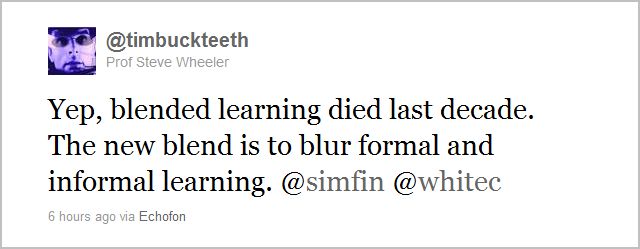
I started a discussion on Twitter today about blended learning, after reading an exchange between @simfin and @whitec. Unfortunately, the limit of 140 characters, on this occasion at least, badly let me down. Now look, just like any other academic, I don't mind a bit of a verbal punch-up, in fact I relish it. If you want an argument, I'll give you one, and just when you think it's all over, I'll come back for some more. But what I don't enjoy under any circumstances being misunderstood. Today's discussion about blended learning on Twitter was for me at least, somewhat unsatisfactory. I was away for some of the time, engaged in editorial work, and as I wasn't able to make my point clearly, I didn't persist. But, knowing me like you do, you know it's not over. So I'm using this blog to elaborate on my ideas in the hope that a more informed discussion can ensue and that this time I will not be misunderstood. Here's what I originally tweeted:


By this statement I meant this: Blended learning (in the established, traditional sense) means a mix of learning activities that involved students learning both in the classroom, and at a distance from the classroom, usually mediated through technology. I am claiming that this type of blended learning - in concept at least - is now outmoded because the boundaries between local and remote have now been substantially blurred. The tyranny of distance has been fractured. My students now learn across a continuum that encompasses the classroom, home and all points in between, any time, any place. They use the same or similar technologies in the classroom as they do at home, as they do on the bus, as they do... you get the idea. Geography (location of study) matters less and less as technology becomes more familiar, transparent and affordable, and students are connected with their peers, tutors and content in continually new and dynamic ways. This is why blended learning, in the old traditional sense is now a fairly meaningless term.


The second part of my statement was more contentious to those who responded to my tweet. I said that the 'new blend is to blur formal and informal learning.' This provoked a storm of responses. Someone said that the idea of formal/informal learning wasn't 'new'. Let me clarify - by 'new' I meant it's a new challenge for teachers. It means they may have to consider replacing some of their practices and it means that schools may need to revise some of their rules. Let me explain again:
Young people now bring so much informal technology into the classroom (mobile phones, handheld games consoles, etc), which they use constantly outside the formal boundaries of formal learning. Without really thinking about it, they use these tools to create and share content, connect, communicate and collaborate for their informal learning. Presently many schools simply ask their students to 'turn off' the devices when they arrive in school, because there are concerns about innappropriate use (cheating, bullying, recording and posting images or videos, etc). One challenge for school leaders today is to balance the risks against the benefits and decide what role if any these informal tools have in a formal context. The major challenge for educators then is to decide whether they wish to harness the power, excitement and allure of these informal technologies with a formal context.

A point was made by Anne-Marie Cunningham that the formal and informal have always been naturally blended by students, and it's nothing new, and to a great extent this is true. However, there is something new we need to consider. With the advent of emerging digital technologies, there are now more opportunities than ever to exploit the potential blend between formal and informal learning. To simply say that it's not new, has always been there, and therefore we don't need to be concerned with it, is ignoring the incredible potential we now have within our grasp to enrich, enhance and extend student experiences.

Mike John implied that because there is only learning and teaching (of which of course I agree) we shouldn't be labelling it with other terminology, because in doing so, we are 'taking our eye off the ball.' I know what he's getting at - the learner should be central - but I counter this by pointing out that if you are discussing the pedagogical theories behind the multitude of different practices observed in the classrom every day (my stock-in-trade) you need different words to engage fully and effectively in the discourse. Differentiating these practices necessitates giving them terms that describe, define and delineate them from each other. Yes, in the final analysis there is only learning and teaching, but we are not taking our eye off the ball in this discussion, we are merely finding out how many ways there are of kicking the ball. Education would be poorer without variety.

Finally, I want to make the point that blended learning in the new sense will also see the boundaries between teacher and learner blurring. I believe the two are a part of a continuum, because we learn by teaching. Sure, the teacher will be paid to develop and facilitate learning processes, but they will accompany students rather than leading them, and students in turn will surely teach each other more. We know that one of the most powerful and persistently positive learning outcomes in all sectors of education arises when reciprocal teaching is employed - the metastudies of John Hattie have established this across multiple contexts. So my prediction is that learning and teaching as activities will blend too. So there you have it. Blended learning as a concept is outmoded, and the new challenge for educators is to bring the excitement and affordances of informal technologies into the formal context. Other boundaries will blur as teaching and learning begin to coalesce. I hope I have been clear, and I'm quite happy to debate this further. Am I right or am I wrong? You tell me.


Creative Commons Licence
New blends in learning by Steve Wheeler is licensed under a Creative Commons Attribution-NonCommercial-ShareAlike 3.0 Unported License.

Friday, 18 February 2011

Lunatic fringe?

Ivan Illich once argued that schools were like funnels, a transmission system - an industrialised, impersonal process that created more problems than solutions. His alternative to funnels was to establish 'learning webs' where students could share their expertise within their communities and learn from each other as the need arose, and as their interests drove them. For Illich, informal learning was more appropriately situated than formal learning, and therefore more relevant for lifelong learning. The work of Paulo Freire holds a particular significance to this discourse - he argued that dialogue was more powerful than curriculum, because it is the essence of informal learning, driven by interests rather than the expediences of the state. Einstein was an echo of these sentiments. He once said: 'Education is what remains after one has forgotten everything he learnt at school'.

During a presentation in Manchester two years ago, I happened to mention that Illich's 1970s notion of deschooling society could now be achieved through new web based tools, but that we were in danger of turning the Web back into a funnel if we persisted with wholesale implementation of institutional VLEs that constrained rather than liberated learning. He is one of my favourite anarchists, I said.

In an online discussion group later, someone suggested that my mention of Illich was enough to brand me as a member of the 'lunatic fringe'. I smiled, because I wasn't offended by this, but genuinely encouraged. A similar thing happened to me during the plenary session of the ICL conference in Austria. I asked a question of one of the keynote speakers, and cited Illich's deschooling position. He lost his cool and declared "No-one quotes Illich anymore!" It's not always a bad thing to be labelled a lunatic. It often means that people just don't fully understand what has been said. It's the same when someone is labelled an anarchist. It is often used as a perjorative description, without a clear understanding of what it actually means.

The Sex Pistols sang 'I am an anarchist', but I'm not convinced they were really aware of the true connotations of their lyrics. One of the conference delegates at my Manchester presentation asked me to explain my statement that Illich was 'one of my favourite anarchists'. He asked me to say what 'other anarchists' I admired. I responded with a list of people including: Jesus Christ, Mozart, Picasso, Van Gogh, Stockhausen, Einstein, The Beatles and Dylan Thomas. A surprising list perhaps? Few of these, if asked, would have classified themselves as anarchists in the sense that they wished to 'destroy the world'. They didn't of course. Most of them were criticised for being mad, deluded, drug-crazed or drunken, but each of them in their own way broke out from the mould, enabling us to see the world in a new way. They created new concepts that made us rethink our representations of reality. To me, that is what true anarchism is. Not being satisfied with the present, anarchy is about challenging, subverting, removing and ultimately replacing the tired, creaking old structures - a kind of 'destructive creativity' perhaps. It may not all be about smashing the system. It may be about repurposing it - just take a closer look at Illich's ideas:

Here is what Illich (pictured left) actually said: “A…major illusion on which the school system rests is that most learning is the result of teaching. Teaching, it is true, may contribute to certain kinds of learning under certain circumstances. But most people acquire most of their knowledge outside school, and in school only insofar as school, in a few rich countries, has become their place of confinement during an increasing part of their lives".

Illich was not saying 'destroy school'. He was saying that the ills of the current state funded school system (read 1971, or 2011 - it makes no difference) far outweigh the good. School is creating far more societal problems than it is solving, he believed. His notion of 'learning webs' reflects his concern that we become more community focused and able to respond to changes, whilst his critique of 'funnels' shows his concern for the bland, homogenous and often irrelevant curricula of his own time and the impersonal, behaviouristic manner in which it was delivered.

On his blog, Bill Ellis provides us with useful insight into the motivation behind Illich's thesis: "Deschooling Society was more about society than about schools. Society needed deschooling because it was a mime of the school system that it engendered and that engendered it. In our current society individuals are expected to work in dull and stultifying jobs for future rewards. This they are trained to do in schools. They go to school so that they can get a job to work for future rewards".

We are seeing some green shoots. Creative curricula and personalised learning environments are the start of the deschooling process Illich called for. The formation of loose networks of practice and virtual communities, professional learning networks (PLNs) and 'user groups' on the Social Web is another. Retiring school systems that inhibit creative expression and individualism, and introducing new forms of assessment that support learning rather than measure it are also the start of the deschooling process. Using appropriate digital media that connect people into expert webs and enable them to negotiate meaning that is relevant to their own specific contexts is infinitely better than direct instruction. I can't see us demolishing the school or university building. What we should see happening though, is building the essence of all that is good from the school and university into each personal learning space, wherever that may be, and whatever form it might take. You can read more about the Deschooling Society ideas of Ivan Illich.

Images: Moon source. Illich source.

Friday, 20 November 2009

True grit

I gave a lecture to the entire 4th year of our Primary B.Ed teacher education programme earlier today, entitled: Educational Values in a Digital Age. Above are the slides that accompanied the lecture. I criticised the worst aspects of formalised schooling where children are taught en masse, and I called for a more learner centred ethos in education. Sure, there is differentiation in schools, but we really don't go far enough, due to lack of time, rigid curriculum and far too few teachers leading to large and often unmanageable classes. But there is an even deeper problem: Teachers are trying to prepare children for work in a world that is constantly changing. I made the point that digital technologies and social media can help to overcome some of the problems teachers face as they get students ready to enter a world of work we can't even begin to imagine yet.

I quoted from Yvonne Robert's book 'Grit: the skills for success and how they are grown', which I picked up after hearing her keynote at Handheld Learning in October. It is a brilliant critique of the current assessment regimes. Roberts argues convincingly that current assessment methods place far too much emphasis on academic qualifications and not enough on self discipline and personal skills. She also points out that teaching literacy, numeracy and science is not enough to prepare children for a world of work which is constantly changing and unpredictable. She calls for more emphasis to be placed on helping students in coping with change, creative thinking and collaborative working.

The 160 students in the group were animated in their discussion of these points, both during and after the lecture. I'm very encouraged by these excellent young people. They are the new revolutionaries - the young, dynamic new teachers that can go into their schools and make a real difference. Let's hope their more experienced colleagues support them and harness their knowledge and enthusiasm.