Showing posts with label augmented reality. Show all posts

Friday, 11 January 2013

The foresight saga

Vuzix M100 Smart Glasses
This is part 8 in the series on the future of learning and technology. At the start of each year everyone it seems, goes into the prediction business. The first week of 2013 saw many articles appearing on what we can expect to see this year. A large number of the articles were about new technology trends, and there was much speculation about how certain technologies might transform our mundane little lives. With the massive Consumer Electronics Show CES 2013 opening its doors last week in Las Vegas, technology news was making prime time TV all across the globe too. The stars of CES 2013 were the Vuzix M100 Augmented Reality Smart Glasses (pictured), Samsung's new ultra thin bendy phone screen and the 4K ultra high Resolution television screen. These are not future technologies. They are technologies for today, 2013. 4K resolution is not enough it seems. Already there are articles predicting beyond 4K into the exotic TV world of the future where transparent televisions (what the...?), and even 'choose your own size' projected wall TVs will roam majestically across the prairies. Entertainment will literally go to the wall.

But what of the future? What are the tech-gurus saying we should look out for this year? The BBC's New Year's eve article 'Who will call it right in 2013?' seemed to hold a competition amongst the illuminated ones, the technology soothsayers of our age. Peering into their digital chicken guts, each gave it their best shot (without sticking their necks out too far, thus avoiding any potential damage to their stellar reputations) predicting what we can all expect to bump into as we turn that chronological corner. The article should perhaps be re-titled 'who will call it at all in 2013?' because many of the so called 'predictions' were banal to say the least.

Robert Scoble (the celebrated blogger) stayed safe and on piste, predicting that 2013 would be contextual. He talked of heads up displays (Google Glasses and the Vuzix M100 are already gearing up for mainstream release) that we could use when we all go skiing (yes, we can all afford alpine holidays in today's burgeoning economy. I'm just nipping off to Gstaad), to brag to your friends through the gift of video evidence just how high you climbed before you fell drunk from the ski-lift, and how long was your 'hang' time on your latest jump. That's if you have any friends left. How's that for context?

Dave Coplin, chief envisioning office at Microsoft (every company should have one) was even safer in his predictions, suggesting that 2013 will be about mobiles, data and trust. More and more, he suggests, data are (he says is) going to be the lifeblood of all our activities. And mobile devices will offer personalisation and  will become the first point of contact for everything we do. Well, who knew?

Mark Cook, chief executive of Getronics UK and Ireland (yep, a household name) takes the prophet's mantle for the safest prediction for the year. He reckons that many companies will move away from BYOD (Bring Your Own Device) to CYOD (Choose Your ... etc). Interesting, as many companies don't even have a BYOD as a policy yet. Cook thinks that CYOD will place the initiative back in the hands of the organisation,  offering employees a device of its own choosing. That's novel. Now why didn't I think of that? I guess you will be able to choose any colour you like, as long as it's black.

So the future is much the same as the present then. I think I'll stick to CES in the future.

Image source

Creative Commons License
The foresight saga by Steve Wheeler is licensed under a Creative Commons Attribution-NonCommercial-ShareAlike 3.0 Unported License.

Tuesday, 8 January 2013

Where AR we now?

This is part 6 in a series of posts on the future of learning and technology. Technology is great for many things, but perhaps its most useful application is enabling us to do things better, faster, smarter. Augmented Reality (AR) is one such tool that has a lot of potential to enhance our senses, but to date has had poor uptake and real life application in the world of learning.  AR typically provides the user with additional information than can be obtained naturally. It takes live views of the real world around you and augments them with computer generated sensory information such as graphics, data, video or sound.

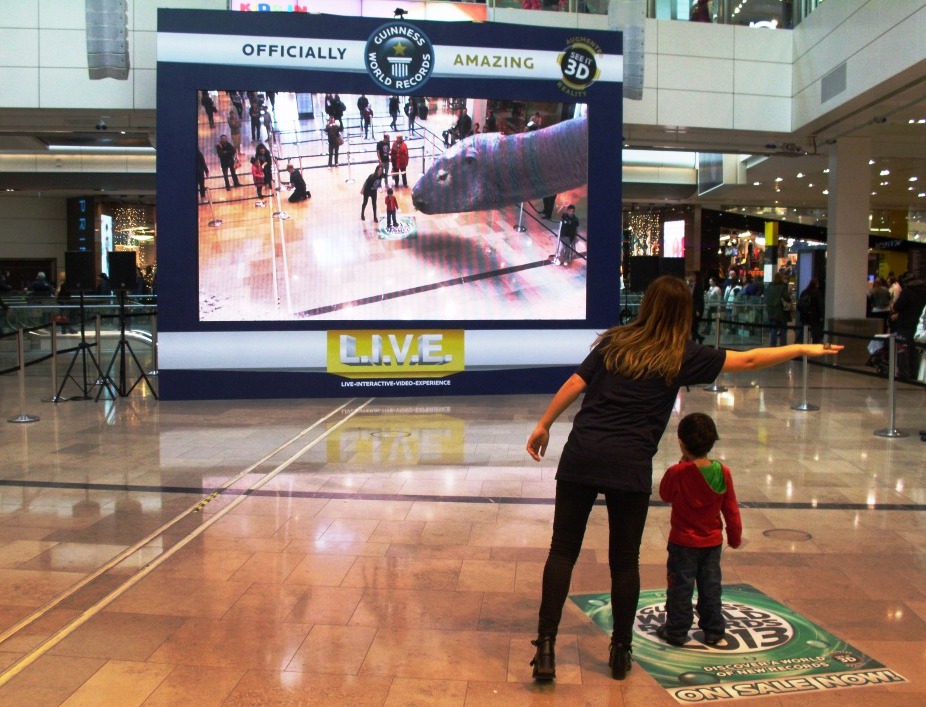
Examples in include smart phone applications such as Layar, which use the GPS and video camera tools to position the user in an information sphere, and feed them contextual information related to that specific geographical location. This can include information about local environment, navigation of complex transport systems (see the embedded video below featuring Acrossair's New York subway app), weather, news and  amenities, as well as cultural or historical information, and even social information. You might for example, wish to discover who else in your location is using Twitter or another social media tool. The opportunities to use such applications in education are fairly obvious, but not everyone has access to the technology, and it can be quite difficult to use effectively if you are able to gain access.  Part of the problem is the inconvenience of having to hold your phone up if you wish to interrogate your environment. A better, more intuitive application of AR is the use of large screens (see the image above, taken in a Westfield shopping centre, London). Better vision, and a more natural means of interrogation of one's surroundings can be achieved using this technology, and objects can be rendered in 3D using simple marker technologies (see BBC this video for a vivid demonstration of some upcoming AR features and uses).


Perhaps the most promising and intuitively easy to use AR version is the wearable (or eye wear) application seen most recently in Google Glasses. A simple heads up display (HUD) is located in the upper right quadrant of one lens of a reasonably normal looking pair of spectacles, and users can control what they see with their mobile phone. Eventually, natural gesture control (such as a head tilt, wink of an eye) or voice control will be developed to enable even more natural and unobtrusive AR use. It has had its problems and suffered a few teething difficulties, but I believe that AR is on its way to a learning environment near you and it will catch on quicker than we expect. Our desire to learn more, and to learn while on the move at any time and in any context, will ensure that the wearable AR device will be available for an affordable price very soon. What educators do with them next, is really down to each individual's creativity and imagination.

Photo by Steve Wheeler

Creative Commons License
Where AR we now? by Steve Wheeler is licensed under a Creative Commons Attribution-NonCommercial-ShareAlike 3.0 Unported License.

Friday, 23 November 2012

Are QR codes redundant?

It seems only a short while since we first became aware of Quick Response (QR) codes. In fact, they have been around since 1994, and were originally created to enable the Japanese car manufacturing giant Toyota to track its vehicles during the manufacturing process. Now QR tags are just about everywhere you look, including advertising hoardings, buses and trains, magazines and even coins. They are essentially two dimensional bar codes that you can scan using your mobile device. The beauty (if you can call it that) of the QR tag is that it will quickly take your mobile device browser to a web site with no other effort than a button click. But as many users will tell you, scanning a QR code can be a little hit and miss.

QR codes have polarised the education community over their usefulness. Some argue that they have no real use beyond faddishness and 'wow' factor, whilst other educators are forging ahead, developing ideas for their pedagogical use. Slowly over the last few years, educational uses have begun to emerge, with some pedagogical applications already being tried out in authentic contexts. And yet, even while QR codes in education are still in their emergent state, questions are being asked about their future, and whether they have already become redundant.

Enter Blippar, an augmented reality tool that is hailed as the QR killer. Apparently it can do everything QR codes can do, but a whole lot more too. I first heard of Blippar when I picked up the November 2012 issue of the ShortList magazine, currently the most widely circulated free men's lifestyle magazine in the UK. The banner headline read 'Special Interactive Gaming Issue', which immediately piqued my interest. From cover to cover, the magazine features, articles, adverts and editorial are all marked with a small yellow 'Scan this page for more' symbol. Using the downloadable app from Blippar, readers can capture the image of the page, which takes them to an interactive website or gaming application. Blippar's managing director Jessica Butcher is fairly triumphant about what she naturally considers to be the advantages of Blippar over QR tags, declaring 'Rather than adding an ugly black and white pixellated box to an ad creative, Blippar can take the creative itself (the whole poster, a logo, the product itself) as the trigger for an interactive engagement.'

She has a point. We certainly wouldn't wish to ruin the aesthetics of adverts, would we? Seriously, I have always thought QR tags to be a little ugly in their appearance. The Blippar app is designed to recognise an image from almost any angle, at a distance, and even in poor light conditions, depending on the quality of your mobile device camera. This makes it a whole lot more reliable than scanning a QR tag, in my experience at least. Just like QR codes, Blippar can also recognise where the user is geographically through the GPS system on the mobile device they are using. For advertisers this is a distinct advantage, but I can also see many educational uses for these features.

Ultimately, those who are speculating on the future of paper based resources might like to consider Blippar and other similar data capture augmented reality tools. The future is likely to see a combination of paper based and e-books, or more likley a hybrid of paper based and AR enabled products, designed to function together with the user's mobile device, working in concert to provide students with interactive learning experiences wherever they are. Paper is not dead yet. It's just become enhanced.

Read the full article here: Can Blippar make QR codes redundant?

Image by Steve Wheeler

Creative Commons License
Are QR codes redundant? by Steve Wheeler is licensed under a Creative Commons Attribution-NonCommercial-ShareAlike 3.0 Unported License.

Monday, 17 September 2012

Uncertainty principles

It's extremely difficult to predict the future accurately, because as futurologist Ray Kurzweil once said, change isn't linear, it's exponential. I often consult The Horizon Report, which is published every year and attempts to predict what will be the widespread adoptions of technologies in education and training. The annual report is published after extensive consultation with an international panel of technology and pedagogy experts. Yet even this is problematic, because the farther you move away from the present, the more opportunity there will be for unforeseen and unpredictable events to occur. And experts are not infallible. You really have to turn to science fiction and read something like Isaac Asimov's Foundation Trilogy to appreciate some of the complexity associated with this kind of uncertainty. What does the future hold? We can't be certain, because right now it's imaginary. The Horizon Report is usually quite accurate in the 1 year cycle. When we examine the predictions in the 2-3 year cycle, it becomes a little hit and miss, and by the time we attempt to predict what will be widely available on the 5 year horizon, it becomes even more tricky to maintain accuracy. The farther out we move in projected time from the familiarity of 'here and now' the less accurate we are in our predictions.

I was invited to speak at the Learning and Performance Institute's annual conference - Learning Live - at St Paul's in London recently, on the subject of Learning Futures, and afterwards talked to Martin Couzins, who recorded the brief video interview below (yes, I know it says 'learning tends'... but perhaps that's a fortuitous error):


Creative Commons License
Uncertainty principles by Steve Wheeler is licensed under a Creative Commons Attribution 3.0 Unported License. Based on a work at steve-wheeler.blogspot.com.

Monday, 28 May 2012

Learning on the move

It was nice to be invited to present a session for Sheffield Hallam University on mobile learning earlier today. The university has quite a strong research group in this area, and my talk, presented online via Adobe Connect had to be on point. Mobile learning is going to be very big indeed. One report suggests that as many as 8 out of every 10 people now having access to some form of mobile communication device. Whatever source you trust, mobile device use is high and rising, leading to the conclusion that mobile learning is clearly an area of development that will  have a massive impact on society in the coming months and years.

Where to start with a subject such as mobile learning? I decided that rather than merely cover practical issues (the 'how to do mobile' approach), I would try to take a more challenging approach, and explore social, pedagogical and psychological theories that relate to mobile technology, and present some of the issues that mLearning practitioners are currently facing. I used several images I have recently captured to illustrate the presentation, including the one above of the free Xbox 360 Kinect areas at Prague Airport, Czech Republic. I predict we will see more of this in public places.  It's interesting, because what we see here is a form of mobile learning without a mobile device. I suggested that mobile learning doesn't necessarily rely on carrying a device around with you, although it is the norm. Perhaps we need to reconceptualise our idea of what mobile learning is really all about.

There are many social implications of mLearning, some of which I covered in my presentation (slides below). I cited Puro (2002) who declared: 'The mobile phone ... is a new kind of stage where the mobile information society is acted out'. This echoes Goffman's (1967) drama theory where individuals manage their impressions in a kind of performance in social contexts. Puro's perspective is that the mobile phone evokes performances from users, but what is in question is the extent to which these performers manage their impression, and how much of this management is conscious effort. Fortunati (2002) speaks of the alienation and isolation that sometimes comes from mobile phone use, and comments that some isolation can be self-imposed, particularly when 'defending the space within which one would like to isolate one's voice'. Anyone who has sat next to someone loudly talking on their mobile phone in a confined space will see the truth, and Puro's expression that - 'the social distance on the mobile stage is small, but the emotional bond may be weak. [The] mobile phone ... may increase contact, but also increase loneliness' - will resonate with many.
There is no denying that at its heart much good learning has a social component. Earlier today in a meeting with one of our training staff, I argued that e-learning needs a social learning element. I suggested that he consider introducing some social media tools into the mix, so that the somewhat 'flat' two dimensional rote learning normally presented was bolstered by some deeper thinking supported by discussion, the creation of content and critical engagement with learning. I believe that mobile devices can help to achieve this mix of content and context based learning.

I explored the question of whether txting is 'dumbing down' language and causing problems. Does SMS text (the unorthodox spelling, or 'squeeze text' imposed by a limit of 160 characters) cause informal language to spill over into formal contexts? David Crystal (2008) says it doesn't. His argument is that in most cases, young people know the differences between communication modes, and that the ethos of language has changed with the introduction of new communication technologies, to the extent that there are now lots of acceptable versions of English. In effect, habitual use of a variety of tools (Facebook, Twitter, SMS, MS Messenger, YouTube, etc) is ensuring that this current generation is more versatile in literacy skills than any previous generation.

Finally, I discussed some of the practicalities of establishing mLearning strategies at an institutional level. There are many constraints, including small screens (a problem for those who require larger screens due to visual impairment or different expectations), bandwidth and connectivity problems, problems integrating mobile devices into institutional VLEs, and compatibility issues across multiple devices. A great article covering these and other issues by Edudemic is entitled How to develop your own mobile learning tools. Each institution has to decide on what basis (if any) it will implement mLearning strategies, which include the need to improve quality of delivery, widening access and participation, and tapping into the huge potential of mobile devices to maximise the study time that is available to each student.

References

Crystal, D. (2008) Txting: The gr8 db8. Oxford: Oxford University Press.

Fortunati, L. (2002) Italy: Stereotypes, true and false. In J. E. Katz and M. Aakhus (Eds.) Perpetual Contact: Mobile Communication, Provate Talk, Public Performance. Cambridge: Cambridge University Press.

Goffman, E. (1967) Interaction Ritual. New York: Doubleday.

Puro, J-P. (2002) Finland: A Mobile Culture. In J. E. Katz and M. Aakhus (Eds.) Perpetual Contact: Mobile Communication, Provate Talk, Public Performance. Cambridge: Cambridge University Press.

Photo by Steve Wheeler

Creative Commons License
Learning on the move by Steve Wheeler is licensed under a Creative Commons Attribution 3.0 Unported License.
Based on a work at steve-wheeler.blogspot.com.

Sunday, 8 April 2012

Get it in glass

What is the best way to merge web with world? Let me put it another way - how can I integrate my online experiences using social media platforms, with what I do out in the real world? For a while, Augmented Reality (AR) has been promised as the next big thing in enhanced technological living.

Many of us have seen the MIT Sixth Sense wearable projection AR demonstration by Pranav Mistry and Patti Maes, and marvelled. Some of us may even have theorised on the potential impact such systems might have on learning.

What about the aesthetics? Wouldn't it be great to 'wear' your computer, and have it project your content over the top of real world objects? And what about the pragmatics? Wouldn't it be wonderful to have access to as much information you want about any object or person you encounter, at anytime, and in anyplace? Those fantasizing about the prospect of owning an AR wearable may soon experience it for real, in an affordable, mass produced version. Google's Project Glass aims to develop a wearable glasses version of an AR system that links your vision and voice directly to all your social media and web based activities, in real time, and against your real world. Below is a video that demonstrates some of the proposed capabilities for users.


Project Glass will do this by projecting visual information over the top of your normal vision, in a see-through heads up display using a glass visor. This is something the military have been able to do for some time, as a means of enhancing information for helicopter and jet aircraft pilots. The military can afford these expensive AR tools. Up until now, the general public have been unable to gain access due to cost.

That all looks like it is about to change if Google can release a version of its Project Glass AR system that is a) affordable b) aesthetically pleasing so that enough people will invest in a set and c) reliable enough to work in the most challenging conditions (e.g. adverse weather conditions and proofed against idiots). There will be plenty of objections from those who want to keep their online lives distinctly separate from their real lives. Health and safety gnomes will also no doubt warn of the dangers of walking in front of a bus while focusing on your heads up display. There will probably be caveats about eye strain and damage from the non-ionising radiation the AR glasses might be suspected of emitting. Regardless of the objections and warnings such a system might provoke, once Google releases its AR glasses to the public, it may signal the slow but inevitable demise of handheld devices such as the mobile phone, and perhaps even the iPad and other handheld computing.

Image source

Creative Commons License
Get it in glass by Steve Wheeler is licensed under a Creative Commons Attribution 3.0 Unported License.
Based on a work at steve-wheeler.blogspot.com.

Thursday, 12 January 2012

10Q: Helen Keegan

We are fortunate to have many innovators in education. In the primary (elementary) and secondary (high) school sectors some can be conspicuous, because through various Teachmeets around the world, and also online during Twitter #edchats, they make their work known to the wider community. In the post-compulsory sectors of education too, there is a lot of innovation and creativity, but sometimes this can go relatively unnoticed.

One academic who personally springs to mind when we talk about creative innovation is Salford University's Helen Keegan. I first met her at a conference in Italy several years ago, and we have been friends ever since. Every time I meet up with her I'm impressed by her energy and drive, and her ability to come up with new and exciting ideas on how to engage learners. In today's 10Q interview, Helen answers questions about her philosophy on learning, social media and her current projects in higher education, including alternate reality games:


Who are you?
I’m Helen Keegan a.k.a. heloukee (online), Senior Lecturer in Interactive Media and Social Technologies at the University of Salford. I’m based in Computing, Science and Engineering, so it’s a great place to be as I get to work with techie students, but nowadays I focus on the social and cultural aspects of technology. I’ve always worked across the University, and am now based at MediaCityUK, which is ideal as it’s a multidisciplinary campus. I like to work across disciplines as I think it’s important for learners to understand different paradigms/disciplinary perspectives/assumptions. My approach to learning and teaching starts from digital identity development – I encourage learners to position themselves in their chosen field while still in education, in preparation for their professional careers.

What inspires you most about learning?
Transformation, empowerment and the unexpected: although learning what we’re ‘supposed’ to learn (I’m talking formal education here) can be empowering, the things that really excite me are often unexpected or accidental – I’m inspired by learners developing new ideas and understandings through making connections between seemingly disparate concepts and fields, and moving beyond their (disciplinary) comfort zone. While this is challenging it often leads to genuinely transformative experiences. Because I work with learners across a myriad of social platforms, I’m able to see them develop their ideas and their identities – both individual and collective - through time. This then drives the curriculum, which is ultimately inspiring: learners being able to confidently negotiate their own curriculum in collaboration with others. In terms of my own practice, students are my primary source of inspiration as reflecting on our learning journey and experiences pushes me to keep innovating. I’m also inspired on a daily basis by people I work with (especially Frances Bell, Ben Shirley and Cristina Costa) and of course my PLN (thanks to social media!).

What/who has been your biggest influence when it comes to learning?
I studied at the Royal Northern College of Music before going on to a degree in Linguistics, specialising in phonetics, speech synthesis and spectrographic analysis. During my time at the RNCM (1993-1995) I was involved in a Manchester-based multimedia collective. With a loan from the Princes Trust, we set up a studio with a 2-tonne acoustic dry room. We had a band (inc. 2 drummers – hence the dry room ;) and an orchestra. My visionary friend Carl Russell led the whole thing, although there were about 15 of us involved on a day-to-day basis. We did all sorts of live multimedia gigs with dancers, animation, video, poetry, classical music, dance music… it’s also how I got into building websites and programming (which led me through the study of Lingustics into Acoustics). It was completely informal, un-assessed, and gave me the opportunity to explore a range of disciplines (music, computing, writing, performing) and learn with a group of friends. It was a major influence on my beliefs with regards to interdisciplinarity, grassroots education and informal learning.

What does social media mean to you?
Connections and networks, serendipity and opportunity, creativity and a rapid flow/spread of ideas – energising and occasionally exhausting! In terms of my practice as an educator, I love the fact that learners can simultaneously be developing their knowledge and understanding alongside their personal portfolio and ‘professional’ online identities. They are able to make meaningful connections with others through expressing themselves as individuals and letting their personalities shine through; their opinions, interests, and activities outside of formal education. I get a real thrill seeing learners develop their digital identities and personal networks over time – I love the fact that the boundaries blur between education/industry, tutors/students, as they build their own networks and gain confidence in connecting with others online.

What is an Alternate Reality Game (ARG)?
An Alternate Reality Game uses the real world as a platform for a transmedia, interactive narrative, which unfolds according to player’s actions. Unlike video games, players don’t play as characters but generally play as themselves, interacting with the ARG designers as opposed to artificial intelligence. ARGs blur the lines between fantasy and reality, requiring collaboration and group problem solving in order to play the game. The overriding mantra for an ARG is This Is Not A Game, so it necessarily involves an element of deception.
 
How have ARGs featured in your work recently?
I recently ran a module as an ARG, as I wanted see if I could pique learners’ curiosity through introducing mystery and intrigue into their course. I worked with Hugh Garry (BBC) who had been involved with a few ARGs in the past, so his experience was invaluable. The students were fed clues in the physical world (within their scheduled classes) and also online, through blogs, Twitter, YouTube and Tumblr. It was quite intense, as we couldn’t control how students would react during the game, so there were a few tricky moments! The culmination of the ARG was the surprise public broadcast of their mobile phone films on the BBC Big Screen in the centre of Manchester – they were led to the Big Screen by a series of clues and puzzles that unfolded during the semester. It was an amazing experience! However, the jury is still out on ARGs – involvement and immersion bring the biggest rewards so there’s a risk of losing or excluding those who choose not to engage, and this was one of the biggest difficulties that we faced.

What other innovative technology supported projects have you been involved in?
The first project I worked on as a researcher/developer still sticks in my mind. My brief was to develop a multimedia CAL package (yes, back in the olden days ;) to ‘teach’ principles of acoustics. I spent a lot of time talking to undergraduate students who were struggling with certain concepts/formulas, and decided to develop a series of simulations that allowed learners to play around with waveforms using sliders, getting instant audio-visual feedback – leaving out the maths (gasp!) until they developed a more kinaesthetic sense of what was actually going on. Learners were able to get a strong feel for things like additive and subtractive synthesis, before moving on to the actual formulas. Once they had a feel for waveforms – both visually and aurally – then the formulas made a lot more sense. Very simple really, but certainly helped learners overcome the mental blocks they had developed as a result of not getting to grips with the maths in the book and on the board.
Another ‘innovative’ project would have been ESMOS – a European project that I directed/coordinated from 2004-2007. The original bid focused on the use of VLEs to support international mobility students (work placements and study exchanges) and I was brought it to run the project once the bid had been successful. I changed the focus from VLEs to open blogs, wikis etc. – might not sound like much now, but it was pretty innovative at the time (2004), and also risky in terms of it being a European funded project as it meant a significant shift away from the original proposal. However, we pulled it off and made a real contribution to international student mobility support (social, pedagogical and cultural), which was recognised by the European commission and had considerable influence on many other projects.
More recent ‘innovative’ projects have included introducing reflective practice and digital identity development through social media into science/engineering in 2006, and getting video technology students in a science faculty to make short films using their mobile phones in order to open their minds to new aesthetics and challenge their rule-governed disciplinary assumptions.

What is your recipe for good learning?
From the content perspective: relevance, personal interest and meaning (also important to understanding learner motivations). I do think emotion is important. A relaxed, happy atmosphere helps people to feel at ease, although that’s not so say that we have to be happy in order to learn - but it does help if learners are enjoying the experience. Open and honest dialogue - admitting that we all mess up sometimes, we all have valuable experiences and thoughts to share, and can all learn from one another. An environment where people aren’t afraid to make mistakes - no fear of saying the wrong thing or ‘sounding stupid’. And last but perhaps the most important ingredients – curiosity, and asking questions!

If you could change anything in higher education, what would it be?
Two things: large class sizes and assessment regimes. This is a personal perspective and not always practical in a mass HE system, but the relationships I have with my students are incredibly important in terms of our learning (I’m including myself as a learner here, because I do expect to be challenged by, and learn from, my students). Sadly, the larger the group, the less likely we are to be able to get to know one another and for me this is one of the most valuable and rewarding aspects of learning and teaching.
My second bugbear is the modularised assessment-driven culture, as this does tend to stifle curiosity. So many learners are focused on what needs to be done to pass a module with a certain mark. It’s a strategic approach to getting a degree, but I’m not a fan of the industrial model of education and sometimes it does feel more like a production plant than a place for imagination and intellectual growth. I don’t believe we should abolish Universities. Universities and academic networks play a vital role in development through research, and linking research to teaching. However, I’m not a fan of corporatisation and get frustrated with the shift towards a consumer culture.

What is your vision for the future of learning?
Greater flexibility in terms of what, where and how we learn; access to information for all; a move away from assessment culture – greater emphasis on curiosity and enjoying learning for its own sake. Alternative forms of assessment and accreditation that allow learners to define their own pathways and form communities of interest/inquiry away from modules and levels. Finally, I’d like to see greater emphasis on critical media literacy, interdisciplinarity and epistemological awareness alongside disciplinary-specific knowledge and skills. Having an open and flexible mindset is becoming increasingly important when we’re living in a rapidly changing world.

Helen Keegan is an invited Spotlight Speaker at this year's Plymouth Enhanced Learning Conference.

Creative Commons Licence
10Q Helen Keegan by Steve Wheeler is licensed under a Creative Commons Attribution-NonCommercial-ShareAlike 3.0 Unported License.

Tuesday, 14 June 2011

New technology and the future of learning

It has been a interesting day. I spent most of it at the Learning Skills Group Conference in Olympia, London. Although I had to leave early to catch my train, I still managed to see the keynote by Chris Bones and the session on assessment by Donald Clark, and my impression overall was that it was a very well received event. There were around 450 delegates for this free event, and Don Taylor and his team are to be congratulated on putting together such a great line up of speakers, that also included Craig Taylor, Cathy Moore, Laura Overton, Nic Laycock, Alicia Sanchez and Charles Jennings. My own session, entitled 'New Technology and the Future of Learning' attempted to gaze (tentatively) into the near future, and to ask questions such as 'what will be the new roles of trainers and developers in the next few years?' and 'what new literacies will learners need to capitalise on new technologies?' I started with a personal journey of over 35 years working in learning technology, and made the point that as each new technology is introduced, there always seems to be opposition and objections. I counselled however, that technology for technology sake is often a mistake. New tech should only be introduced if there is a good reason - for enrichment, extension or enhancement of learning, when it can't be achieved using existing methods. It's very dangerous to try to predict anything, because we are often wide of the mark. But we can trace the trends and see the strong possibilities. I therefore made several broad brushstroke predictions that the future of learning will be: open, personal; social; mobile; augmented; and visual. I spoke about some of the new and emerging technologies such as augmented reality, magic symbol technology and infographics, as well as some of the already established technologies such as gestural interfaces, social media and smart mobile devices. There was an excellent discussion around the questions posed, and I daresay discussion will continue. Below is the slide show (with some additional annotations), to prompt you to join in with the discussion if you weren't able to personally attend the event.


Creative Commons License
New technologies and the future of learning by Steve Wheeler is licensed under a Creative Commons Attribution-NonCommercial-ShareAlike 3.0 Unported License.

Thursday, 3 February 2011

Heating the house or burning it down?

My public keynote yesterday in the trade fair arena at the LearnTEC Trade Fair and Conference in Karlsruhe, Germany was quite an experience. I wore a microphone headset which made me feel like an astronaut (but alas none could be found, despite the close proximity to Darmstadt European Space Agency Centre). The headset didn't make me look like Michael McIntyre, but it certainly gave me a lot of freedom to move around the audience and interact dynamically with them, and with over 300 people crowding in from all parts of the arena, we had an interesting and fast moving session. I presented a talk entitled: The future of learning: Web 2.0, Web 3.0 and the eXtended Web (Slideset here) which seemed to capture the mood of the conference. They like talking about the future here at LearnTEC, even if it is uncertain (the future, not LearnTEC - which seems to be growing from strength to strength, already in its 19th year, with 6000 exhibition visitors and 1200 conference delegates over the three day event).

I talked about how the Web, in all its incarnations, is changing the way learning can be conducted, and discussed the impact of mobile technologies. We touched on a number of new and emergent technologies including augmented reality (AR) and non-touch, natural gesture interfaces such as the XBox 360 Kinect and MIT's Sixth Sense wearable. At the end there was at least 15 minutes of questions and discussions, and I could tell from the questions that everyone seemed to be thinking deeply about what was being said. It was an ideal environment for this presentation, as hopefully the pictures above will show. To be deep in the heart of exhibitor land, and with many of the exhibitors leaving their stands to participate, just has to be a way forward in the context of the debate on the divide between vendor and practitioner (see the comments on my previous post for the discussion thread).

One of the comments from conference convenor Prof Peter Henning was that the discovery of fire was a game changer. I added in my response that perhaps it was not the discovery of fire that was so important, but the discovery of the ability to make fire. We discussed the disruptive innovation of the Gutenberg Press (invented so close to Karlsruhe, in Heidelberg) and its role ín democratising knowledge. Previous to movable type setting, publishing was extremely limited, but with the introduction of mass affordable publishing came the need to develop the entire population's literacy skills. My message to the audience was that with the introduction of social media and semantic web technologies, a new disruption is now occuring - and we now need new literacies - digital literacies for the entire population. We also discussed how to harness the excitement and richness of informal learning within formalised contexts, and how the future of learning will rely for its success on preparing young people not to learn facts (which are often outdated by the time students graduate) but to instill within them all the ability to learn how to learn, solve problems and adapt quickly to changing situations. The final message for the audience was that just as with fire, web tools have the capability to be used skillfully, or badly, and without care. We can either heat the home, or we can burn the house down.

Image source by Gudrun Porath

Creative Commons Licence
Heating the house or burning it down? by Steve Wheeler is licensed under a Creative Commons Attribution-NonCommercial-ShareAlike 3.0 Unported License.
Friday, 19 November 2010

eXtending the Web


I was up at stupid o'clock yesterday to present a webinar for the ASCILITE organisation - the Australasian Society for Computers in Learning in Tertiary Education. The time zone differences meant that my audience, distributed across Australasia, was listening to me in the evening, while I was sat in my office in jeans and a T-shirt at 7 in the morning, armed with copious quantities of caffeine and a box of matchsticks. While I talked, as if by magic, the sun removed itself from Australia and New Zealand and reappeared outside my window. I was actually up an hour earlier at 6 am finalising and uploading my slides onto ASCILITE's Wimba platform, and then making sure the technical details were all in order. But I enjoyed it. The audience were very knowledgeable, and asked some pertinent questions.

My subject was "The eXtended Web - New and Emerging Learning Technologies" - it was essentially a gaze into the future of e-learning where smart mobile technologies create a ubiquitous learning context, and where semantic software predicts your needs even before you ask the computer. It's not too hard to envisage this, including 3D manipulation of virtual objects and natural gesture driven learning, and of course the use of augmented reality for learning and context awareness while on the move. The technology is already here, in both handheld and wearable versions - as I try to depict in my slides above - but it may take some time before everyone who wants access to them can have it. We shall see - it's hazardous predicting the future, especially where technology is concerned, but we can watch the trends and see where the road is leading. We live in exciting and challenging times, and we can expect to see a lot of changes taking place in the next few years in the world of education.

Creative Commons Licence
eXtending the Web by Steve Wheeler is licensed under a Creative Commons Attribution-NonCommercial-ShareAlike 3.0 Unported License.

Thursday, 22 July 2010

New spaces, new pedagogies

I'm kicking off the new academic year by presenting a keynote paper at the Annual International Conference of the Royal Geographical Society in London on Thursday, September 2nd. The session is entitled Innovative spaces of learning: debating their origin, nature and pedagogical significance, and is a sub section of the main RGS conference. Others speaking in the session include Derek France (University of Chester), Ruth Weaver (University of Plymouth) and Wendy Woodland (University of the West of England). Here's the abstract for my keynote:
New Spaces, New Pedagogies: Harnessing the Power of Social Media in Education

A rapid emergence of social media – the so called ‘Web 2.0’ – has opened up new opportunities for participatory learning in all sectors of education. Students now have the capability to create and share their own content through blogs, wikis, video- and photo-sharing services such as YouTube and Flickr. They can easily connect into and maintain contact with multiple communities of interest, gaining access to experts using social networking tools such as Myspace and Facebook. They can organise their own resources through free and easy to use tagging and social filtering tools. In this presentation I will argue that this rapid rise of user generated content is blurring boundaries between novice and expert, and challenging the traditional notions of knowledge, ownership, privacy and identity. In tandem with this, the proliferation of personal devices such as iPods and smart mobile phones is enabling students to move beyond the boundaries of the classroom into ‘any time, any place’ learning. In the light of these developments I shall explore new teacher roles, examine new learner expectations and explore some of the new learning territories that are emerging beyond the walls of the institution. I will offer some examples of how Web 2.0 tools have already been harnessed to support professional mentoring and to promote deeper engagement in learning through collaboration and reflection. I will discuss the concept of the personal learning environment and its potential to enrich student experiences. I shall speculate on the potential impact of emerging technologies such as augmented reality and touch screens and their potential in shaping the future of education.

Image source

Creative Commons Licence
New spaces, new pedagogies by Steve Wheeler is licensed under a Creative Commons Attribution-NonCommercial-ShareAlike 3.0 Unported License.
Based on a work at steve-wheeler.blogspot.com.

Saturday, 17 July 2010

Web x.0 and beyond

I'm amazed and delighted at the huge response to my slideshow Web 3.0: The Way Forward? which started out as a brief analysis of current thinking on how the web might be extended beyond social tools into a more smart and responsive personal environment for learning. Before long it was an invited presentation given to a small gathering of enthusiastic teachers at a Vital Meet seminar. As I write this post, just 4 days after posting it up onto Slideshare, the slide set has already received 5,500 views and has been embedded into at least 20 other blogs and websites. Web 3.0 is clearly a topic that catches the imagination of many people in education and beyond. I like Stephen Downes' comments on my use of the term Web x.0 in the diagram adapted from Nova Spivak:

"The idea of Web X is that it combines web 2.0 (social web) and web 3.0 (semantic web) to create what I have called .... the semantic social web. But it's more than just that, because it takes these and moves them off the web and into your hand. And more than just that, because it's the web of data, the geoweb, augmented media, the 3D web, and more. The eXtended web - the web, extended from the internet, into your life".

This was an acknowledgement of a trend I had tried to highlight in my slideshow - that intelligent content and tools can now be operated from your mobile phone while you are on the move. I believe we will see this trend continue, with geomashups and augmented reality applications becoming more common place, enabling learners to navigate not only content on the web, but their actual, physical environments too.

George Siemens also weighed in with a response:
"The development of the semantic web, linked data, and open data, coupled with location-awareness, recommender systems, augmented reality, data overlays, and similar developments is having a dramatic impact on how people interact with information and each other".
He also is particularly focused on how these tools can be used to improve learning.

So it's not only Web 2.0 and Web 3.0 we need to consider, but extensions beyond these into a truly integrated, fully responsive and entirely personalised learning environment that fits into the palm of your hand. This is my vision for the future, but as I continually warn - predicting the future can be hazardous. I wrote about this problem in a recent post entitled 'Seeing the future'. The U.S. Mayor who in 1880 announced that one day every town in America would have a telephone was right, but also so far wide of the mark, it's almost laughable. So when people ask me when we will see all of these tools being used for learning, I simply smile and say - "we'll see". We know the tools exist (see: The Future is the Web) we just don't know when they will become economically viable enough for institutions to begin investing in them wholesale. Perhaps they never will. Perhaps it will be down to individual learners to purchase their own devices and applications. Perhaps this will be another aspect of the 'do it yourself' personal learning environment ethos we are all talking about.

Creative Commons Licence
Web x.0 and beyond by Steve Wheeler is licensed under a Creative Commons Attribution-NonCommercial-ShareAlike 3.0 Unported License.
Based on a work at steve-wheeler.blogspot.com.

Friday, 15 January 2010

New smart devices

I was asked some time ago if I was interested in giving a presentation at Learning Technologies 2010. To be honest, I knew very little about this conference, which will be held this month at Olympia in London. And yet it seems that with over 4000 delegates pre-registered for the event, it is one of the largest learning technology training and development events in Europe. I had a long telephone conversation with the conference chair, Donald H Taylor, discussing the possible content of my presentation and we eventually agreed that I should talk about new smart devices. Don wanted me to move the discussion on from the smart phones, toward an area where augmented reality tools are being introduced into training and development contexts.

And so here it is: my slideset which I will present on 27 January in London at Learning Technologies 2010. I hope to meet as many people as possible in my session at Learning Technologies, but if you can't be there, at least you will be able to see my slides. And of course, as ever, any constructive feedback is very welcome.


For those who take their slides with a little music, here is the same slideshow on Animoto (with an unplugged version of Shine by Take That) courtesy of @james_wilding. Thanks James!