Showing posts with label GPS. Show all posts

Tuesday, 8 January 2013

Where AR we now?

This is part 6 in a series of posts on the future of learning and technology. Technology is great for many things, but perhaps its most useful application is enabling us to do things better, faster, smarter. Augmented Reality (AR) is one such tool that has a lot of potential to enhance our senses, but to date has had poor uptake and real life application in the world of learning.  AR typically provides the user with additional information than can be obtained naturally. It takes live views of the real world around you and augments them with computer generated sensory information such as graphics, data, video or sound.

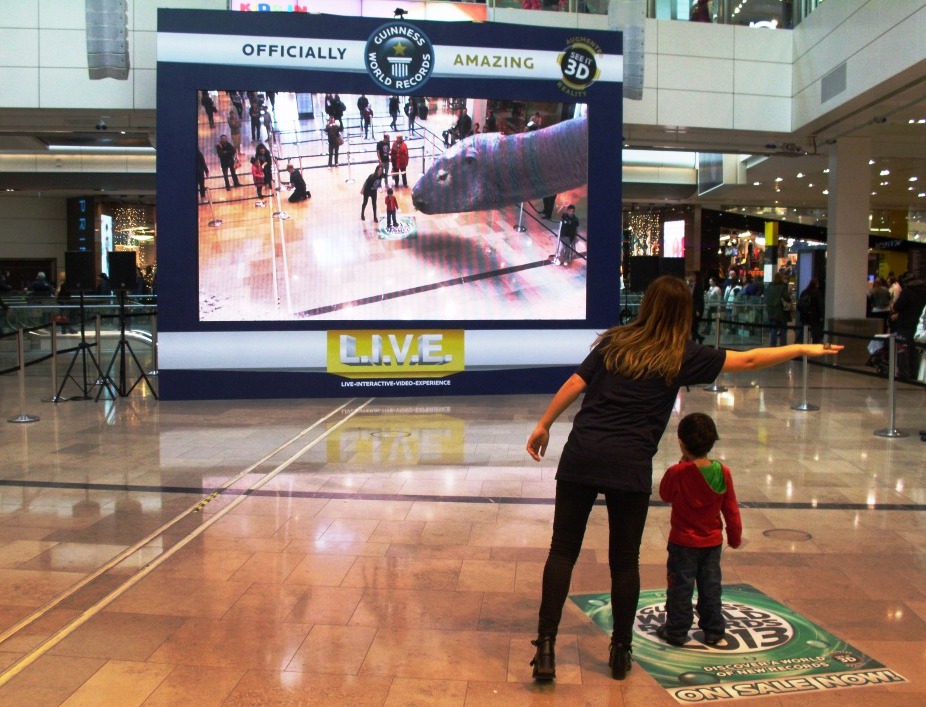
Examples in include smart phone applications such as Layar, which use the GPS and video camera tools to position the user in an information sphere, and feed them contextual information related to that specific geographical location. This can include information about local environment, navigation of complex transport systems (see the embedded video below featuring Acrossair's New York subway app), weather, news and  amenities, as well as cultural or historical information, and even social information. You might for example, wish to discover who else in your location is using Twitter or another social media tool. The opportunities to use such applications in education are fairly obvious, but not everyone has access to the technology, and it can be quite difficult to use effectively if you are able to gain access.  Part of the problem is the inconvenience of having to hold your phone up if you wish to interrogate your environment. A better, more intuitive application of AR is the use of large screens (see the image above, taken in a Westfield shopping centre, London). Better vision, and a more natural means of interrogation of one's surroundings can be achieved using this technology, and objects can be rendered in 3D using simple marker technologies (see BBC this video for a vivid demonstration of some upcoming AR features and uses).


Perhaps the most promising and intuitively easy to use AR version is the wearable (or eye wear) application seen most recently in Google Glasses. A simple heads up display (HUD) is located in the upper right quadrant of one lens of a reasonably normal looking pair of spectacles, and users can control what they see with their mobile phone. Eventually, natural gesture control (such as a head tilt, wink of an eye) or voice control will be developed to enable even more natural and unobtrusive AR use. It has had its problems and suffered a few teething difficulties, but I believe that AR is on its way to a learning environment near you and it will catch on quicker than we expect. Our desire to learn more, and to learn while on the move at any time and in any context, will ensure that the wearable AR device will be available for an affordable price very soon. What educators do with them next, is really down to each individual's creativity and imagination.

Photo by Steve Wheeler

Creative Commons License
Where AR we now? by Steve Wheeler is licensed under a Creative Commons Attribution-NonCommercial-ShareAlike 3.0 Unported License.

Tuesday, 31 May 2011

One step beyond

Earlier today on Twitter I said: 'To use any social media to its full potential in education you must venture beyond the classroom.' And I meant it. To achieve its optimum effect, the use of any social media - whether it be blogging, wikis or any other form of sharing of content - must breach the walls of the traditional learning space. Social media are time and space independent. They do not operate within, or rely upon, traditional ways of learning. Nor do they exist within a single timeframe. We need to see them in this context, not just as software and content on a computer screen, but as a gateway to a huge network of connections in an ever expanding global community. Facebook isn't just about friends and family anymore. It's about friends of friends, and connections to groups and online communities.

The ability to transcend the boundaries of the classroom is absolutely one of the best affordances social media provide. I have written in the past about opening up classrooms, not just the doors, to let others see what is happening and celebrate - but to let others in to the experience when they would previously have had no chance of sharing the joy of learning with you and your students. I wrote that open classrooms should also let your students out - to communicate, collaborate, and create together with other students across the globe. Traditional learning has never been that successful at achieving this, no matter how many exchange visits or pen pal schemes were instigated. Now we have the chance to take our classrooms out into the world on a global scale, never before possible.

The use of blogging, as several schools (primary/elementary and seconday/highschool) are already discovering, has the powerful potential to expand and extend students' experiences to a new level of enrichment, where interaction with students in other countries, or even just around the corner in the same city, are paying huge dividends. When they receive comments back from their peers, young bloggers are spurred on to write and create more and at a higher level of quality and achievement than ever before. It's a very powerful motivator.

The use of GPS in smartphones, working in concert with geo-specific social media such as Foursquare; the context aware systems now being introduced into museums and art galleries; QR tags and magic symbols; the Augmented Reality applications that are now proliferating - all of these and more are now avialable for teachers to exploit. We are merely limited to our own imaginations.

So what are we waiting for? Child safety and protection issues are always at the forefront of teachers' minds when they plan for blogging or other social media based learning activities. Health and safety, risk assessments for those venturing outside the coziness and 'safety' of the traditional classroom. All of these have to be considered, but if we make them an excuse for not being adventurous, we will miss the boat. Ask the outdoor schooling movement for their views on this. Let's set the kids free.

Image source by Paul Tomlin

Creative Commons Licence
One step beyond by Steve Wheeler is licensed under a Creative Commons Attribution-NonCommercial-ShareAlike 3.0 Unported License.

Wednesday, 19 January 2011

The social impact of disruptive technology

Steve Wheeler, Associate Professor of Learning Technology at the University of Plymouth, will give a public keynote on February 2 at the LEARNTEC Bildungsforum, in Karlsruhe, Germany. Being a self-declared 'disruptive activist', the subject of his speech 'The Future of Web 2.0 Technologies in Learning' is very close to the core of his professional interests and endeavours. In the following interview he talks about the necessity of harnessing the potential of Web 2.0 for education and training.

Prof. Wheeler, which technologies do you consider "disruptive” and what has Web 2.0 to do with it?

Disruptive technologies are game-changers, they fundamentally change the manner in which things are done. Let me give you the example of digital photography: Today there are only a few places left where you can buy non-digital cameras. There is hardly any need for them. The same can be applied to Web 2.0. Just take Wikipedia: Technically it is a collaborative work space for creating content. In fact it has thoroughly overturned the idea that you need to consult a printed encyclopedia to get expert information. If you find a mistake, you can instantly correct it yourself, you do not have to wait for the publishing house to decide on an updated next version. The internet has literally changed our lives.

Why do you think it still necessary to push for further change and to pursue "disruptive activism”?

We have to realize that the way teaching is conducted in many schools and universities is actually outdated. It no longer applies to the current world of young people and does not answer to the needs of society anymore. But change does not happen by itself. I am very much interested in learning psychology, in the way people behave, how they perceive technology and how they use it in teaching and learning, and I have learnt from my research that there are and always will be many people who are resistant to change or reticent about it, because disruptive technologies challenge their social and professional roles. This is also my personal experience, from the very first time I used computers to train nurses in hospitals in 1986.

There are around 7.000 authors for the German Wikipedia edition. Do you think this has a big social impact?

The basic idea behind Wikipedia is that everybody can be an editor and a commentator. This idea sways the balance of power between experts and non-experts, between teachers and students everywhere, because it rejects the privileged role of former knowledge mediators and contradicts the traditional idea that knowledge can only be generated by certified experts. People who take an interest in a certain subject are able to generate knowledge about it - and consider themselves capable of doing so.

Are these changes mostly discernible for internet researchers like you or do you think the people involved - teachers and students - are also aware of them?

The reactions are different. There are many who embrace these changes, probably more in the educational and academic sector than in corporate training. But there are also ostriches that put their heads in the sand and don’t want to see what happens around them. Others don’t accept the idea that students have the same status as lecturers. They don’t like Wikipedia to be referenced (in academic assignments) because they don’t trust anything which has not been formally peer-reviewed. Of course, what I write on my blog is not institutionally checked, which is different to a publication in a scientific journal which may go through two blind peer reviews. But in fact my readership reviews and comments on what I write, and this in a way is more valuable to me than a formal review. There is more immediacy to it and there is a personal bond between me and my readers. Wikipedia and weblogs were two of the most important applications of Web 2.0, when Tim O’Reilly coined the term in 2004.

Today everybody talks about Facebook and Twitter. What do they offer for learners?

Facebook is very interesting as it attracts a wide variety of people from teenagers to older people. But we should not confuse Facebook with formal learning. Some people try to harness it for this purpose, but I think the potential is quite limited. Twitter is less distracting, it is more streamlined and has a more appropriate range of features that makes it a better teaching tool than Facebook. You can share conversations and knowledge, but you cannot play. You can use filtering tools, if you do not want to read everything written by all the people you follow. If I want to know something about a particular topic, I go to my Twitter account and put a short message on the screen, asking for information. Within minutes I get some very clear answers. I get information fast and I get in contact with people who are experts in this particular field. You have mentioned a lot of disruptive software applications.

Is there also hardware with similar effects?

Smartphones are disruptive. Of course they can be used inappropriately, e. g. for cyber bullying. But imagine 30 children in a classroom, every one with a mobile phone: Why not use it in a controlled way, for example as a voting instrument, as a tool for messaging, or in order to link up with media that you cannot normally access in the classroom? Cell phones seemed to be a tool for talking to anyone in any place. But today they are much more: You can send text, gain access to the net, use your camera, orientate yourself by using GPS systems, capture augmented reality. We would be very stupid to ignore these possibilities.

The future of learning is about the mobile phone?

Definitely. It will be a platform for many future developments, such as context-aware technology. You will see more virtual content around you: overlays on billboards, in airports, on sightseeing venues. If you take students into a museum, the virtual information about the artwork, the artist etc. will be embedded into the painting you are looking at. At the end of the day you go back to your classroom and you download the complete information about what you have seen and decide what you are going to do with it.

What is the future of Web 2.0?

Well, this is the subject of my LEARNTEC lecture. Let me just tell you that the transition into Web 3.0 will be very semantic, very meaning-based. It will lead to the classification of knowledge through folksonomies and to the extended web which combines social and information richness. The future is very exciting.

For further information on Steve Wheeler see his weblog. Presentations are available here at slideshare. Vorträge: Public Key Note: The Future of Web 2.0 Technologies in Learning (Messebereich) 02.02.2011 13:45-14:45

Creative Commons Licence
The social impact of disruptive technology by Steve Wheeler is licensed under a Creative Commons Attribution-NonCommercial-ShareAlike 3.0 Unported License.
Monday, 4 January 2010

The future is the Web

I'm putting together my invited presentation for Learning Technologies 2010 later this month. I have been asked to talk about the new smart technologies that we will be using in the next year or two. These include touch screen technologies (iPhone, Touchtables, etc), augmented reality (AR) devices (6th Sense, Layar etc) and other emerging technologies such as QR tagging, GPS and wearable computers. I will talk about how I think these might be used to support, enhance and extend pedagogy in the future. It's quite a tall order, but if you know we well, you also know I relish a challenge.

I'm going to use Web 2.0 (and the emergence of Web 3.0) as my starting point. I know a lot of people don't like these terms, but as I have previously commented (see Lost in Translation), even if it isn't the right one, the name evokes meaning and makes the concept comprehensible. At least most of us will know what I mean by Web 2.0 (the read/write Web - connecting with others) and Web 3.0 (The semantic Web - connecting with knowledge content through 'intelligent' search/filtering). I'm starting with them because whatever technology we will use in the future for teaching and learning, we can be assured it will have a social element and that we will increasingly rely upon intelligent (agent) systems to get us from where we are to where we want to be. The future is digital, and the future is the Web.

The future will be interactive. The way we interact with the Web will be different from the way we interact now. We are already seeing signs of shifts in use, moves away from mouse and keyboard toward natural hand and finger movements, such as multi- and pinch-gestures. The iPhone was one of the first handheld devices to capture this, but we already had interactive whiteboards in classrooms that could operate on a touch basis. It's now one small step away from that to interaction in 3-D, where we move around in physical space, and the computer tracks and responds to our hands, eyes and voice. AR tools will recognise what we are doing and then enhance it by adding information to the world around us.


The future will also be mobile. I have already elaborated on why we need to be more mobile and agile in a previous post, but I will emphasise here that learning and working on the move is going to increase exponentially in the coming years. It will increase because we are more mobile as a society than ever before and we need to maximise the limited time we have each day. The demands on an individual's time are increasing to the point that many people now need to learn how to work smarter not harder, by doing more in the down-time that is otherwise wasted waiting or travelling. Increasingly we will see people using handheld smart devices to augment personal reality, access information, communicate, navigate their way through physical space and create and share content while on the move. Many of us are already starting to do this.

Finally the future will be sensory. One of the words we will increasingly hear in 2010 is the word 'haptic.' Haptic - pertaining to the sense of touch - describes the manner by which some new technologies are providing tactile feedback to users through handheld controllers. When it's your turn on Wii sports, your handset makes a small sound, a blue light flashes, and it vibrates. The handset alerts several of your senses simultaneously. Mobile phones also have a built in vibration alert when you want to go silent but still want to know a call or text is incoming. We are witnessing the early stage of haptic consumer technology. It will get better as it becomes more widely available, and more control will become possible using haptic tools. Humans have more than the 5 traditional senses Artistotle talked about. At least three - equilibrioception (balance), proprioception (sense of limb juxtapositions) and kinaesthesia (motion) - are there waiting to be tapped into, to make our interaction with digital media more natural, responsive and effective.

I'm going to try to make some sense of all this for my audience. Together, we will discuss ways in which new smart technologies can enhance education and training, and make learning more exciting and relevant for our students.

Learning Technologies 2010 will be held at Olympia 2, London, on January 27-28.

Image source

Thursday, 4 October 2007

October 4 and all that

Today is a momentous day. I was just a four month old baby at the time, but my cradle was rocked, I can tell you. You see, today is the 50th anniversary of the day the space race started. Some might cynically say it was at the expense of the human race. Maybe, but when the USSR (remember them - they did a world tour in the 1960's) launched the world's first artificial satellite - Sputnik - we entered into a new era of telecommunications which eventually evolved into a vast global network that now enables us to receive live television pictures from virtually anywhere in the world. Without satellites there would be no GPS, no iridium satellite mobile telephony and no whole host of other things we have since discovered we 'can't do without'. Google Earth is a classic example of satellite imagery in action.

I have dedicated an entire page of my eLearning @ Plymouth website to satellite communications if you care to take a look. I spent a considerable time in the 90's working on a project where we regularly used live digital satellite television to deliver distance education to a large reception area covering most of Western Europe. We still have a satellite research centre at the University of Plymouth. You could say that satellites have played a big part in my life.

October 4th is momentous for me for another reason. Today is my 21st wedding anniversary. I'm off now to buy some flowers....

Friday, 31 August 2007

Top 7 topics at this year's ALT-C

In preparation for the forthcoming ALT-C 2007 conference, I glanced over the content of papers, posters, workshops and symposia on offer. It interested me to see that some key topics have emerged as the front runners for discussion. A quick trawl of titles and keywords revealed these top 7 favourite topics:

e-Learning 31
Web 2.0 Social Software 25
VLEs 24
Blogs 20
Mobile learning 19
Social networking 18
Wikis 16

No surprises really.... There are also a number of other papers dealing with accessibility, e-assessment, student perceptions, and various learning applications use such as VOIP, videoconferencing 3-D virtual worlds, podcasting, mini-games, e-portfolios, and of course ‘learning objects’ (whatever they are…) Even GPS and Interactive Whiteboards have a small presence. I was also interested to note that there are only 6 papers featuring the term ‘distance learning’ (although several more imply it) – but ..... could this be a sign of the decline of this old term? Has distance education now been overhauled in the glittering world of learning technology? We shall see….