 |
| The Muse Headband |
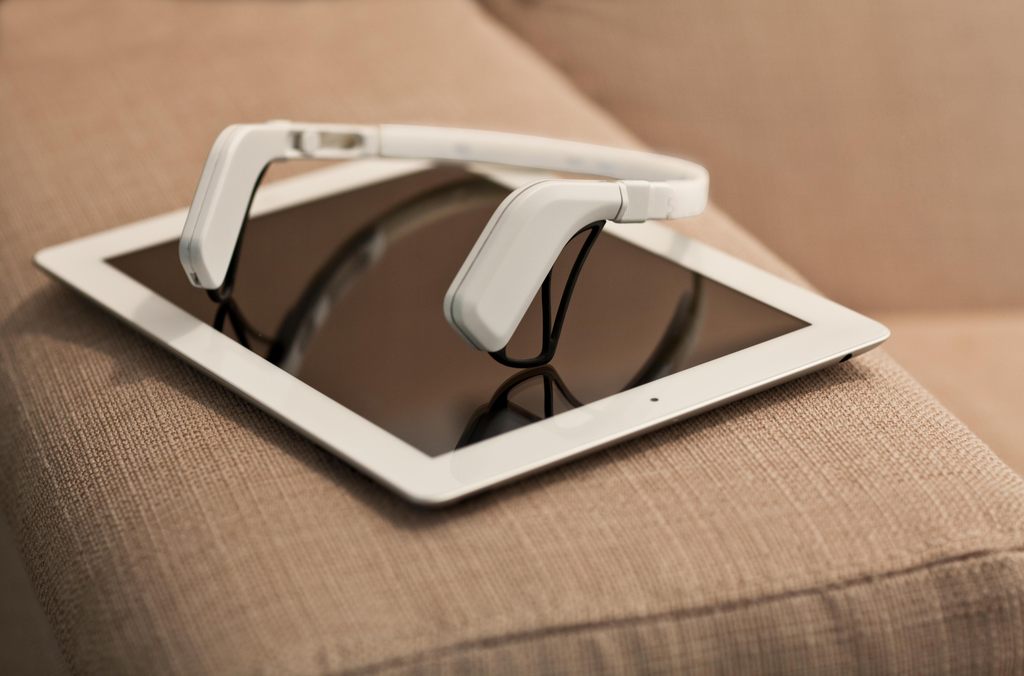
They have finally done it. Someone has come up with a way to control computers using mind power. And the device is non-invasive. At least, that's what InteraXon, the company who has designed the Muse 'brain sensing' headband wish to achieve. 'It lets you control things with your mind' runs the sensational strapline for the
Muse Headband promotional video. Mind control? This will sound quite sinister to many, and others will be far from convinced. After reading the authoritative but still controversial book Physics of the Future by Michio Kaku recently, I have a more open 'mind' on the matter. I don't doubt the claims InteraXon make, or at least I won't when I get to see Muse demonstrated with my own eyes. But I think 'brain sensing' is an unfortunate tag line. Could it imply that there is no brain there to sense? Are they perchance anticipating that brainless people will buy the device? To me 'brain sensing' infers that it is detecting whether there is a brain present, rather than the more spectacular functionality it can potentially offer. Perhaps InteraXon ought to revise their tag line so it more accurately represents the capability of the device. You see, Muse is actually a wearable Electroencephalograph or EEG, with 4 sensors that are positioned strategically around the Alice-band style headgear that you wear.

If you can get past the irritatingly repetitive and slightly-louder-than-it-should-be background music on the video, and ignore the embarrassing geekiness that exudes from some of the presenters (I think it's really cool!), the Muse headband does look like it has the potential to be a breakthrough technology. The last time we had a true technological breakthrough of any magnitude was 7 years ago, when Microsoft released the Xbox 360 Kinect. Kinect was truly revolutionary because it pointed up all sorts of possibilities around non-touch, voice activated, natural gesture computing, at an affordable price. The simple juxtapositioning of two cameras made all the difference. All you had to do was think creatively, and hack the system to get that Tom Cruise,
Minority Report (The future can be seen!) action going. Will Muse have a similar impact to Kinect? Will it launch us into a new era of control technology? Time will tell, because at present Muse is still in an early stage of development, and InteraXon are speculating themselves on its potential to bring advances into the non-touch, thought control of devices.
At present, InteraXon are offering advance devices for a mere US$165, on the understanding that you test out the system for them. What is currently on offer goes in one direction only. The Muse Headband will be configured to measure your 'brain activity' and transfer an analysis to your laptop or iPad. The device will measure areas of your brain as they activate while you play a 'brain training game'. The manufacturers claim that it will enable you to exercise your memory, measure your attention span and practice relaxation techniques. But is Muse more than simply a measuring device? Later, promise InteraXon, using the data they collect, there will be the possibility of using next generation Muse Headbands to control computers and other devices by mind power alone.
The future has a habit of creeping up on us from behind. And it does it quicker than we sometimes imagine it can. We once thought voice control was science fiction. Enhancing our senses was fine for vision, hearing, even speech. We have prosthetics for all of those. But we have carefully steered away from any mind enhancement. We didn't have the technology. We left that kind of thing to Star Wars, magic and folklore. Now it seems, we have the technology, and at the moment, mind control is right at the edge of our imagination of what technology can possibly offer. From motion sensing to mind sensing in just 7 short years? Who would have thought it? How soon before thought controlled computing becomes a reality for us all? And what then will we need to do (or to become), to adjust to the brave new world that will be upon us?
Images by InteraXon

Headline Muse by
Steve Wheeler is licensed under a
Creative Commons Attribution-NonCommercial-ShareAlike 3.0 Unported License.