I'm packing frantically to travel down to South Africa and onwards to Namibia tomorrow, volcanoes and strikes permitting. My destination is first Johannesburg, and then a short flight onwards to Windhoek, capital of Namibia, where I will be giving an invited presentation to the UNESCO Open Educational Resources Conference organised in conjunction with the Commonwealth of Learning. I'm looking forward to attending the conference, and visiting another African nation. I learn so much every time I venture out of my own country, and often use the things I see in my writing and presentations. My last trip overseas a few weeks ago was also to Africa, to the Gambia, on the West coast, where I saw a lot of stuff that really opened my eyes to the incredible poverty most of the world's population live in. If you ever get complacent about life, go to Africa. My thoughts about education and its purpose changed radically as a result of my one week's stay, as you can see if you read my post What Price Education?Namibia is not such a poor country as the Gambia, but I anticipate that I will once again be challenged by the places I visit, and the sights I will see. I had never dreamt I would go to Namibia - it was just another place on the map. But the invitation came out of the blue last month and so I jumped at the chance. My talk, mainly courtesy of Ulf-Daniel Ehlers (and also with thanks to Carmen Holotescu) is based loosely around the question: 'What's so Good about Open Educational Resources?' In it I will try to outline some of the benefits I can see in its use for individual learners, teachers, institutions (schools, colleges, universities), professional networks, and communities of practice. I will be interested to hear the feedback from my audience when I present on Monday. I will say more about my Namibian excursion when I return, hopefully in time to cast my vote in the UK General Election on Thursday.(The picture above is one I took of an old fisherman, looking out over the sea in the Gambia).
 Learning with 'e's
 by
Steve Wheeler is licensed under a
Creative Commons Attribution-Non-Commercial-Share Alike 2.0 UK: England & Wales License.
Based on a work at
steve-wheeler.blogspot.com.
 This post is dedicated to all my students who are currently in the process of writing up their e-learning research assignments. Writing is still a central component of academic success and always will be. Yet many students still keep making the same simple errors - failing to proof read before they submit, typographical errors and grammatical errors could so easily be eliminated if only they took a little more time.As usual, I have held several tutorials with each of my students, but there is no substitute for going back to look over the rules of the English language, getting grammar right, steering clear of repetition and avoiding all the avoidable little syntax errors you could of avoided. 1. Verbs has to agree with their subjects.2. Prepositions are not words to end sentences with.3. And don't start a sentence with a conjunction.4. It is wrong to ever split an infinitive.5. Avoid cliches like the plague. (They are old hat)6. Be more or less specific.8. Parenthetical remarks (however relevant) are (usually) unnecessary.9. Also, too, never, ever use repetitive redundancies.10. No sentence fragments.11. Don't use no double negatives.12. Proofread carefully to see if you any words out.Good luck to them all. :-DOriginal source of the above content on how to write good.And here's some more of them rulesImage source
 I'm reading James Surowiecki's excellent book 'The Wisdom of Crowds' at the moment. I was particularly taken by his introduction in which he relates the story of Sir Francis Galton, and his discovery, against his own assumptions, that collective intelligence not only exists, it is generally correct in its judgements. Galton's experiment was based on a 'guess the weight of an ox' competition in which 800 people participated. His statistical analysis of the results showed that as a collective mean score, the people guessed accurately to within one pound of the actual weight. This discovery of the people's collective ability ('democracy' as he called it) to make decisions that are of the most benefit to the people, attracted me for a number of reasons. Firstly, Galton made his discovery in a farm show in Plymouth, England (my home town). Secondly, Galton was one of the UK's first psychologists (I trained as a psychologist too), and although I disagree profoundly with many of his ideas about intelligence, which led him to champion eugenics, I can't help but admire the way he trailblazed his ideas about human behaviour, forensic psychology and statistics long before other, more famous psychologists. Thirdly, his scientific integrity is inspirational. Against his own deep seated beliefs, and in opposition to his previous scientific studies, the results of his 'West of England' regional fare research showed that in fact, when a crowd is asked to make a decision, they usually get it right.
James Surowiecki goes on to argue that the principles behind this idea can explain everyday activities including the stock market, democratic voting processes, gambling and even the fact that when you go the a convenience store at 2 am for a carton of milk, there is one there waiting for you. The wisdom of crowds even explains the phenomenon of Web 2.0 and social networking tools, and specifically, as we have long understood, it defines why web services such as Wikipedia and Google Search have become so popular and accurate over the last few years. Surowiecki argues that in many cases, the judgements of larger diffuse crowds of people is actually more accurate than the decision making of smaller, more elite groups. I have clung to this ideal in the development of many of my recent teacher education programmes, into which I have incorporated collaborative and co-operative online tools such as wikis, so that students can create, share and negotiate their learning related content. If you haven't read Surowiecki's book yet (it was first published in 2004), do try to get hold of it. You can purchase it quite cheaply on Amazon (another wisdom of crowds example) and I promise you, it is a very good read. It's also, dare I say it, an effective foil to Andrew Keen's book 'The Cult of the Amateur' which warns against the dangers of Wikipedia and similar web repositories, describes what I can loosely term as 'stupidity of mobs'. If anyone has read both books and cares to provide a valued judgement on them, the comments box below is ready for you... Learning with 'e's by
Steve Wheeler is licensed under a
Creative Commons Attribution-Non-Commercial-Share Alike 2.0 UK: England & Wales License.
Based on a work at
steve-wheeler.blogspot.com.
 I'm swabbing the decks me hearties! Yep - it's time to do some spring cleaning, so I just deleted my Friends Reunited account. Had to really, because firstly I have never really used it - it feels just a little old and outmoded now - and secondly, I kept receiving annoying little updates via e-mail. I wouldn't have minded so much if the FR message didn't persist in starting with 'Stephen...' Look, no-one except my mother and Graham Attwell (no they are not the same person) has called me 'Stephen' in a very long time. If they do I'll not answer. I'm Steve to my friends and colleagues (note the distinction) and Tim to those who are a little confused about my digital identity. Not Stephen. That's guaranteed to get my back up every time. I got shot of my Friends Reunited account in the same way I did with Plurk, Bebo, Myspace and a whole host of other not so useful tools. Facebook survived by the skin of its teeth, mainly because at the time I was (just a little bit) obsessed with Farmville, and also because a lot of my friends still communicate with me on my Facebook wall. (It's also a sureptitious way to keep tabs on my two teenage daughters, but don't tell them - they don't read this blog, so I hope I'm relatively safe mentioning it here... maybe). Facebook has some uses, so I'm keeping it. However, Twitter and my blog are now my most important Web 2.0 tools. There are a few others - you can read here about my top ten web tools. On reflection, the reason I have been shedding so many of the services I so naively blundered into during my early days using the social web, is because they become a little like old clothes. I'm told that if you don't wear a garment for 6 months, you are probably very unlikely ever to wear it again. It's the same with many web tools. Suddenly they aren't so useful anymore. You leave them derelict, and don't use them for a few months, and they become like old clothes. You forget your password and can't be asked to request a reminder. Unwanted, probably outgrown, and looking slightly worse for wear - these old spaces go past their sell by date. I give my old clothes away to charity shops, or dump them if they are beyond repair. A purge now and then of old web tools I no longer frequent feels like another part of my life laundry.Image source
'Swabbing the decks' by
Steve Wheeler is licensed under a
Creative Commons Attribution-Non-Commercial-Share Alike 2.0 UK: England & Wales License.
Based on a work at
steve-wheeler.blogspot.com.
 I was recently invited to write a post for the Dell Education blog. Below is my article, which first appeared on the Dell website on 22 April, 2010. In my role as an academic researcher in learning, I am often asked the same question: What is so innovative about ICT in schools? I assume that people ask this question because they are so used to seeing computers they have forgotten what the world was like before they arrived. I usually respond by starting off with an examination of what ‘ICT’ actually means. ICT - Information and Communication Technology - is more than just computers. In education, it’s really better referred to as ‘learning technology’ and I made my views clear about this recently in a blog post entitled ‘Stop calling it ICT!’. Whatever we call it, it’s a term that embraces an entire spectrum of tools, including the Internet and World Wide Web, telecommunications, cameras and audio, mobile phones, computer games, and other interactive devices in the classroom, such as Interactive Whiteboards, turtles and pixies (small programmable floor robots) and voting systems. We limit our vision if we simply see learning technology as ‘computers’, but I concede that computers are often the gateway into many of the above tools.
So just what is so innovative about this spectrum of tools? There are three key points I want to make to answer this question, and they all relate to what I term ‘affordances’ – the attributes of the technology that we perceive are useful to us. I wrote about this recently in a post on my own personal blog which I called ‘Angels in the Architecture’. The first innovative quality of learning technology is that it has a flexibility and provisionally that supports learning across the sectors, from reception classes through to higher education and lifelong learning. Remember the time when you had to retype something, or use Tippex, if you made a mistake? You probably won’t if you are under 35 years old. When word processors were first introduced into education, they were an absolute Godsend to many people, particularly students who were writing long essays or teachers who had to create a large amount of content. The provisionally of the computer, not only in terms of text manipulation, but also images, sounds and video, means that the computer and learning technology in general have become indispensable for most people who find themselves studying or teaching. Secondly, learning technology can be a platform for creativity. Creativity is often overlooked in learning – especially if it’s not art or music. We need to acknowledge that creativity is an important aspect of learning across the curriculum. We need to think laterally when trying to solve some mathematics or science problems for example. When we write essays, read literature, or learn a new language, we need to call upon our imagination and creative skills to make sense of the learning resources. Learning technology supports, and often extends our creative skills, and can act as a ‘mindtool’ for us to develop our thinking skills too. We can store all our thoughts, useful collections of knowledge and questions in the memory of our device, and then leave it there until we next need it, thereby freeing up thinking space for the immediate problems at hand. Thirdly, and probably most importantly, learning technology is very effective in connecting people together, and enabling them to share their ideas, resources and comments online. Social networking tools, blogs and wikis are just a few of the tools that are in common use in education, where students and teachers can create content, share, discuss, vote, and otherwise participate in a community that extends beyond the boundaries of the traditional classroom. We are only at the start of the innovation curve of learning technology. The provisionally and flexibility of the tool, its capability to harness and amplify creativity, and its ability to connect people together wherever and whenever they are in the world, will ensure that learning technologies will continue to be innovative in education. There are many more things I could say about the innovative nature of the tools that we call ICT – the learning technologies – but space and time do not permit. In conclusion, I will give this word of advice to any teacher in any sector of education: Don’t be afraid to take some risks with technology – if you can think of an idea to use in your classroom, it is very likely that there is a learning technology tool out there that can help you realise it.Image sourceLearning with 'e's by
Steve Wheeler is licensed under a
Creative Commons Attribution-Non-Commercial-Share Alike 2.0 UK: England & Wales License.
Based on a work at
steve-wheeler.blogspot.com.
 In December last year, the UK's very own Prince of Darkness, Lord Mandelson, declared that 2 year degrees would be the future of higher education. The Business Secretary ordered a 'shift away' from traditional three-year degrees, despite warnings that shorter degree programmes might dilute academic standards. His reasoning is that 2 year degrees would free up more spaces for undergraduate study across all disciplines, and ultimately, there would be less expenditure, and less student debt. All well and good. But to deliver the so called 'fast track' degrees, universities will need to work smarter than ever before, and will need to adopt better flexible learning methods. This is where learning technologies will come to the fore.
We are holding the first UK national conference here at the University of Plymouth, on June 18th (which just happens to be the anniversary of the infamous Battle of Waterloo - I don't know why I pointed that out - may be an omen) where keynote speeches, workshops and other activities will highlight what universities will need to do to ensure standards are maintained whilst adapting to fast track degree delivery. Among the speakers at this free event will be Professor John Traxler (Wolverhampton University) who will talk about: 'Mobile Learning vs Fast Learning: On the Same Track?' and Mark Stubbs (Head of Learning and Research technologies at Manchester Metropolitan University). It should be a great day - and if you are in the region and free on that day, you may want to attend. Remember - it's a free event. Go to the conference website to register.
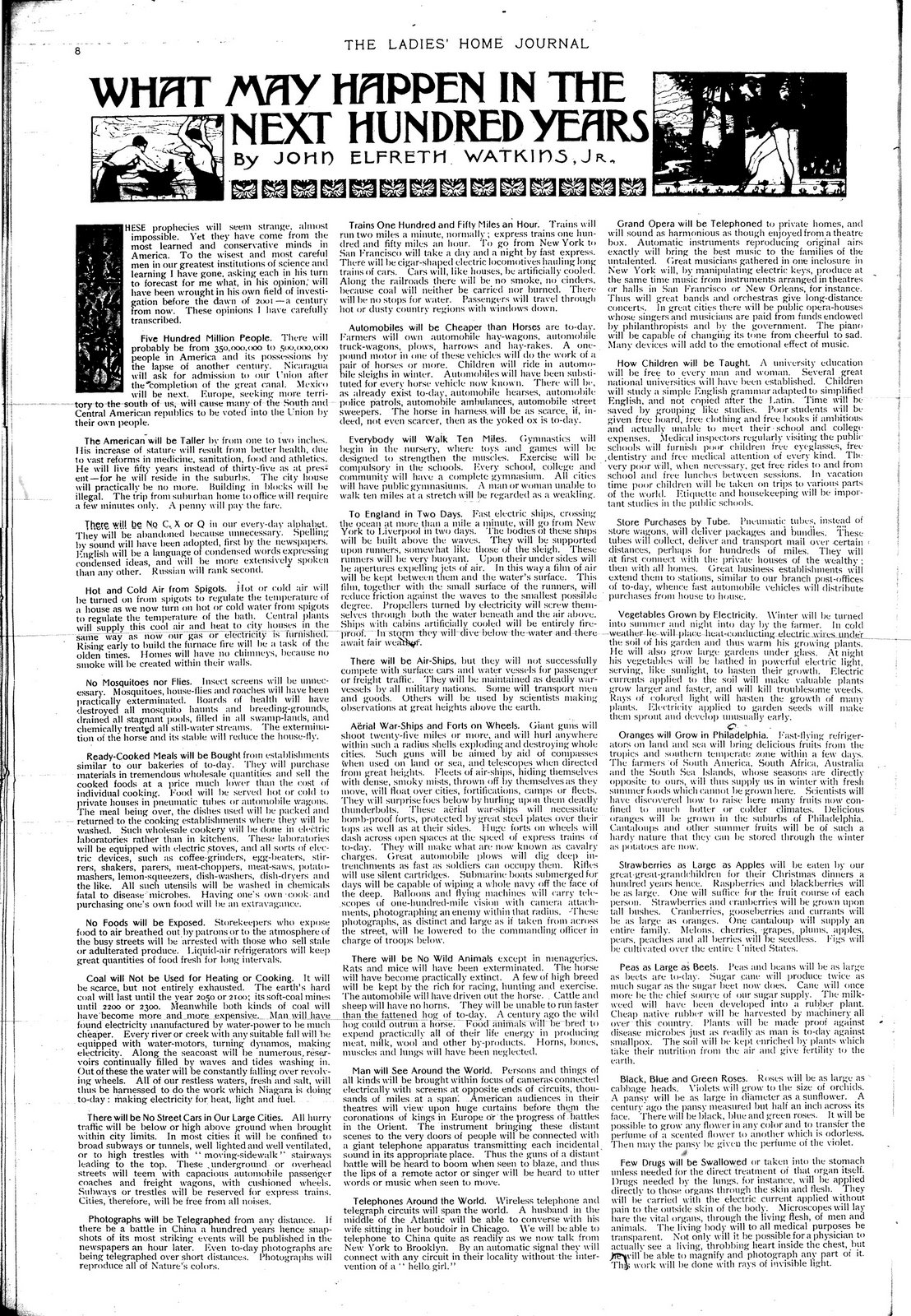
 It's a risky business, this 'seeing into the future' lark. If you get it wrong, you look like an idiot. In ancient times, a prophet's life depended on whether he got it right. In the old testament sories, being a 'false prophet' was actually a crime. Prophets who got it wrong were put to death. That's why the smart ones predicted stuff that would happen hundreds of years later. If it didn't happen, they were no longer around to get whacked. Nowadays, many people consult clairevoyants and fairground crystal ball gazers who tell them what they want to hear. It's very much a psychological game in which the 'fortune teller' fishes away by questioning, and watches body language to see if they can gain a purchase on their client's life story. Many of us remain fascinated by the apparent ability to see into the future. A lot of people revere the likes of Edward Cayce and Michael Nostradamus for the long range forecasts they made that appear to be uncannily 'accurate'. But both, although seemingly accurate in some ways could also be said to be playing a similar game to the fortune tellers. The criticism is that their generalised statements could apply to any number of world events at any time. Predicting the future of technology is just as risky, even though we can often detect trends. Several eminent scientists have got it very wrong when they have tried to predict technological trends. Thomas Edison for example, famously claimed that moving pictures would one day make books redundant. They patently hasn't happened, and even though devices such as Amazon's Kindle are making e-books available to us all, paper based books have not been supplanted. Another famous gaffe came from Thomas J. Watson (then the head of IBM) who in 1943 was alleged to have said that he saw a world market for about 5 computers. There was the U.S. Mayor in a wild west town who, when he saw Alexander Graham Bell's new invention - the telephone - demonstrated for the first time, declared bullishly 'One day every town in America will have a telephone!' He was right of course, but his prediction was also so far off that it's now laughable. Virtually every person in America has a telephone, and many carry them around in their pockets. I was intrigued to read an article that was written back in 1900 in a magazine called 'Ladies Home Journal'. The article entitled What may happen in the next hundred years is both startingly accurate, and laughingly off-beam. It predicts for example that by the year 2000, cars will be cheaper than horses. It predicts that by 2000, coal will no longer be used in our houses to heat or cook with. It predicts that there will be aerial warships and forts on wheels. All of these are startlingly accurate if you look at the fact that the motor car has been the preferred mode of transport for families for decades, coal fires and cookers are no longer used in the majority of western homes (although some coal fired power stations remain, there are alternative methods in predominance) and wars have been fought since World War 1 using fighter planes and tanks. By far the best predictions in the article though, are these: Wireless telephone and telegraph circuits will span the world (Internet?); Photographs will be telegraphed from any distance (Flickr?); And this one: Man will see around the world. The article says: 'American audiences in their theatres will view upon huge curtains before them the coronations of kings in Europe or the progress of battles in the Orient. The instrument bringing these distant scenes to the very doors of people will be connected with a giant telephone apparatus transmitting each incidental sound in its appropriate place.' That's the part that really grabs me. Satellite TV, large screen technology and worldwide television coverage are now taken for granted. In 1900 they were science fiction. If you ignore the archaic language, the article is actually a very accurate set of predictions about future technology. I think it would be difficult to do the same again though, standing in 2010. Technological progress is a lot faster now than it was in 1900, and even predicting what might happen 5 years down the line will be problematic. That's my prediction.Image source
'Seeing the future' by
Steve Wheeler is licensed under a
Creative Commons Attribution-Non-Commercial-Share Alike 2.0 UK: England & Wales License.
Based on a work at
steve-wheeler.blogspot.com.
 I'm packing frantically to travel down to South Africa and onwards to Namibia tomorrow, volcanoes and strikes permitting. My destination is first Johannesburg, and then a short flight onwards to Windhoek, capital of Namibia, where I will be giving an invited presentation to the UNESCO Open Educational Resources Conference organised in conjunction with the Commonwealth of Learning.