Showing posts with label Internet. Show all posts

Saturday, 19 January 2013

We need a rethink

There's a very useful and refreshing article by Tom Barrett in this week's TES Magazine entitled 'Education needs to plug into Web 2.0'. Never before have I read an article that I agree with so completely. Those of us who are immersed in a world where the use of social media is so sustained, embedded and familiar, forget that many schools still ban the use of Web 2.0 type tools in their classrooms. Tom has some advice for schools who are in this category, and I quote:

"Perhaps one of the biggest barriers to engaging with the social web in schools is the perceived issue of safety: many teachers say they are left feeling helpless when pupils' work is available on the World Wide Web. I have been blogging with classes for eight years and these common-sense guidelines always work:

1) Be open to parents and allow them to share any concerns.
2) Moderate all comments before they are posted online.
3) Have a clear and robust e-safety policy.
4) Work within the school policy on images of children on blogs.
5) Publish a set of blogging guidelines on your site and share them with parents.
6) Make sure the whole school community is aware of your work."

Common sense indeed, but I would also add that schools should encourage and permit children to help teachers co-create the e-safety and school policies on social media use. They use these tools outside of the school on a daily basis and often have a sophisticated grasp on how social media work. Who better to inform schools than the users themselves?

I once spoke at an event where a school leader remarked that his school had banned access to blogging, YouTube and all other social media because 'they are dangerous'. I countered by asking him whether we should also stop teaching children how to cross the road, because traffic is dangerous too? I think he got the message. Where better to teach children about the dangers and risks of using the Internet, than in school? I think a rethink is very much overdue.

Whether this blog post, or Tom's article, or any number of other good pieces of advice will have an impact on the impasse many schools find themselves in with relation to social media use in schools, remains to be seen. But just a few moments thinking about the risks (and balancing those up against the clear benefits social media have in schools who do allow them) should convince most school leaders that adopting social media in the classroom really is the best way forward.

Image source

Creative Commons License
We need a rethink by Steve Wheeler is licensed under a Creative Commons Attribution-NonCommercial-ShareAlike 3.0 Unported License.

Thursday, 27 September 2012

In an Internet minute

The futurologist Ray Kurzweil once said that 'change is not linear, it is exponential.' Sociologist Alvin Toffler described three waves of evolution in our interaction with tools. The first two, the agricultural and industrial revolutions laid the foundations for the larger, Third Wave - the technology revolution. Prior to the technological wave,  life changed relatively slowly, and change was linear, but in the advent of new technologies, we are lurching from change to change without pause. The technological Wave has changed everything in life, including the way we work and trade, learn, provide healthcare, entertain ourselves, conduct our relationships and interact. Arguably, old rubrics which described, but did not govern the pace of technological change (see for example Metcalfe's Law or Moore's Law) may already be outmoded.

The infographic on this page illustrates the sheer volume of  user generated content and user activity that occurs every 60 seconds somewhere on the Internet. In one minute there are over 2 million search queries on Google, 6 million Facebook views, over 200 million e-mails sent and 100,000 tweets. These staggering metrics are only the tip of the iceberg. We can expect to see exponential rises in all of these and the emergence of new and more dynamic social media and communication systems. One of the most marked changes are the upsurge in the use of mobile technology, with 1,300 new mobile users every minute. Mobile phones, tablets and laptops are portable gateways into the Internet, and it is predicted by 2015 that there will be twice as many mobile devices on the planet as there are humans. This means that access to the Web will increase, and there will be a steep rise in Internet activity, probably beyond what we can ever imagine. This assumes that the growth rate will continue at its current pace, which of course it won't. It also assumes that people will (and are) using more than one device to access the Internet. I currently have 3 devices with me, and I'm using two of them to write this blog post.

Whichever way we look at this, we know beyond reasonable doubt that demands on the Internet will continue to rise. Are we prepared for this exponential rise in use? The biggest challenge facing us now is not how to use the Internet, but being able to futureproof it so that we have enough bandwidth, capacity and storage space to hold all of the user generated content that is coming. Another challenge is to ensure that the Internet improves in terms of speed, security and usability.

Image source

Creative Commons License
In an Internet minute by Steve Wheeler is licensed under a Creative Commons Attribution 3.0 Unported LicenseBased on a work at steve-wheeler.blogspot.com.

Saturday, 1 September 2012

Promoting change in schools

In yesterday's blogpost I discussed the problems of change management in schools and suggested that the biggest barrier to the successful adoption of new technologies lies in the minds of teachers. The attitudes of  teachers toward new technologies for example, are shaped by their perceptions of the usefulness of these technologies in day to day practice. In 2005 I edited a book entitled 'Transforming Primary ICT' (Wheeler, 2005) in which I authored a chapter on change management. Here is an extract, much of which, I believe, still holds true today:

The arrival of information and communication technologies (ICT) in the primary classroom has produced some astounding outcomes. For many, teaching and learning has been transformed, with new methods and practices often emerging as a direct result of the use of computers. The internet has unleashed countless new resources and caused teachers to rethink what teaching and learning are all about. Electronic records and databases enable the classroom practitioner to access a wealth of useful information that was previously out of reach. Tedious and mundane jobs can be automated, liberating teachers to concentrate on the more creative aspects of their professional practice. ICT is quite simply transforming primary education, and it is doing so at many levels.

Teachers have met the rapid uptake of computers in schools with both positive and negative responses. From a positive perspective, ICT brings a number of clear advantages for the teacher and the learner, which encompass new resources, new ways of teaching and new ways of learning. The internet, for example, can provide children with access to a vast repository of information, learning resources and experiences. The use of interactive whiteboards can enhance lessons by providing teachers with a range of new delivery methods and teaching resources. Use of e-mail can cut down response time from days to minutes, with teachers connecting to each other, school governors, Local Education Authorities, suppliers, specialist teachers and advisors, and of course, pupils and their parents. In short, the introduction of ICT has the potential to radically alter the face of teaching and learning in schools.

Less positively, ICT has been instrumental in alienating many teaching staff, causing them to question their role as educators, and engendering a great seal of disquiet and anxiety for the future. With any change comes uncertainty and, in the case of the computer, this change has been all pervasive. It is no wonder that some teachers feel threatened by technology. (pp 7-8).

Seven years on from writing this piece, I am seeing schools adopting technologies and embedding them within the curriculum. Things are improving, but there are still many schools who lag behind, either due to lack of vision or leadership, lack of resources, or a fear of the implications of technology. The latter may be one of the most trenchant barriers to the adoption of new technology in schools. In my next post, I plan to explore 'technophobia' and how it impacts of the adoption of new technologies in education.

References
Wheeler, S. (Ed.) Transforming Primary ICT. Exeter: Learning Matters.

Image source

Creative Commons License
Promoting change in schools by Steve Wheeler is licensed under a Creative Commons Attribution 3.0 Unported LicenseBased on a work at steve-wheeler.blogspot.com.

Thursday, 14 June 2012

Dialogue, debate and destinations

I don't have the time or the inclination to calculate how many miles I have travelled in the last week, but it involved three car journeys, 11 train rides, numerous taxi trips and one flight. I managed to keynote four conferences in six days, respectively eLearning 2.0 at Brunel University, London; the CILIPS annual conference at the Apex Hotel in Dundee; the Solstice Conference at Edge Hill University, and finally the Digital Literacies Conference at Southampton University. I spent much of my time gazing out at the countryside going by from the windows of trains, but during the times my feet were on firm ground I did also manage to have some decent and productive conversations with old friends and new, and fielded questions from delegates during my presentations at all four events.

Some notable discussions took place, some of which I can briefly summarise here on this blog. I took issue for example with a statement by Rosemary Goring (Literary Editor and columnist for The Herald) who keynoted the CILIPS conference on Monday. She suggested that Libraries should conserve their traditional roles and that any change that took place should be 'geological'. Goring was essentially arguing that libraries should not be dictated to by technological changes, but in doing so she missed a fundamental point. Libraries must change, because the needs and perceptions of users is changing. In my own keynote speech the following morning, speaking to an audience of around 200 library and information professionals, I argued that libraries need to become more flexible and agile (and indeed many already are), to respond to new learning practices, and an increased interest in knowledge and research. Co-incidentally, in their packs, each delegate received a copy of Panlibus Magazine, containing an article written by me entitled 'Moving away from books'. I remarked that before they burnt me at the stake for heresy, there should in fact have been a question mark at the end of the title. The jury is still out on the future of paper based content, but for the record I see no immediate demise of the book. The question is: do you like reading or do you like books? (acknowledgement to James Clay for this question). If you like reading, then any avenue of enquiry (kindle readers, e-books, online search, even audio) remains open, whereas if you insist on reading only from books, then your scope is increasingly limited. I cited the fact that for the first time this year, Amazon is reporting selling more e-book downloads than it is paper based books. This and other technology driven changes demand that libraries move quickly to adapt to new trends and remain agile to maintain relevance in a digital age.

Other noteworthy debates took part at Solstice and the Digital Literacy conferences during the week. I was challenged by delegates at Solstice to elaborate on the legal and ethical issues of Creative Commons and other Copyleft approaches. Creative Commons, I explained, is a means of circumventing Internet Copyright constraints. It seems perverse in today's adverse economic climate, said Brian Lamb, to hoard knowledge in any form. I added to this that in a time when knowledge is needed more than ever, why do we allow edubusinesses and greedy publishers to commoditise knowledge and publicly funded research? I advocate giving content away for free, by publishing it (as with this blog post) under a Creative Commons licence that allows anyone to take any or all of the content for reuse, as long as they attribute the source and re-licence it under the same conditions (share and share alike). Many academics, I argued, feel uneasy about giving content away for free, preferring to perpetuate the old ivory tower mentality. But give away we must, if we are to reach audiences that extend beyond our own little academic fraternities. Gone are the days when we can rest on our laurels by publishing our research to a small and select group of elite scientists. The general public also need to know about advances in science, medicine, technology and education, and the best way to do this is to publish openly. I gave another challenge to those present to boycott closed journals, and publish in open access journals. I was not calling for publishers to give away journal content for free, but simply to reduce their prices to reasonable rates so that the average student can afford access. The ethics of this are clear - publicly funded research has been paid for out of taxes. It should therefore be made freely available to those who have paid their taxes.

Finally, a note about the Digital Literacies Conference at Southampton (pictured). With Salford University's Cristina Costa, I presented an 'unkeynote' - a kind of plenary workshop - and we had a whale of a time disrupting the proceedings and causing a great deal of mess and chaos. Yet out of the chaos came some order, from social tagging, online collaboration, critical thinking and intelligent searching activities, we led toward round table discussions, delegates explored the spectrum of new literacies that are emerging as a result of the introduction of new technologies into formal learning contexts. After several quick-fire 10 minute presentations, the second unkeynote, presented by Doug Belshaw and Sue Beckingham dwelt on essential elements of digital literacies, and was drawn largely from Doug's recent doctoral thesis. Doug helped us to think about digital literacies in a sort of periodic table of 8 'c's - their slideshow is here. As each table came to grips with the Cultural, Cognitive, Constructive, Communicative, Confidence, Creative, Critical and Civic aspects of using technology to learn, we were then asked to choose two and develop a learning activity around them. The result was a lot of great ideas that could be incorporated into learning activities in any education sector. Doug and Sue concluded an excellent presentation with the quote from Johnson (2008) who said 'functional internet literacy is not the ability to use a set of technical tools; rather, it is the ability to use a set of cognitive tools'.

I thank all of my hosts in London, Dundee, Ormskirk and Southampton for making me feel so at home. The Storify record of the event by Ivan Mendelez and the Flickr image collection by Farnoosh Behraman have captured some of the dynamics and atmosphere of the conference.

Images by Farnoosh Berahman

Creative Commons License
Dialogue, debate and destinations by Steve Wheeler is licensed under a Creative Commons Attribution 3.0 Unported License.
Based on a work at steve-wheeler.blogspot.com.

Tuesday, 20 April 2010

Seeing the future

It's a risky business, this 'seeing into the future' lark. If you get it wrong, you look like an idiot. In ancient times, a prophet's life depended on whether he got it right. In the old testament sories, being a 'false prophet' was actually a crime. Prophets who got it wrong were put to death. That's why the smart ones predicted stuff that would happen hundreds of years later. If it didn't happen, they were no longer around to get whacked.

Nowadays, many people consult clairevoyants and fairground crystal ball gazers who tell them what they want to hear. It's very much a psychological game in which the 'fortune teller' fishes away by questioning, and watches body language to see if they can gain a purchase on their client's life story. Many of us remain fascinated by the apparent ability to see into the future. A lot of people revere the likes of Edward Cayce and Michael Nostradamus for the long range forecasts they made that appear to be uncannily 'accurate'. But both, although seemingly accurate in some ways could also be said to be playing a similar game to the fortune tellers. The criticism is that their generalised statements could apply to any number of world events at any time.


Predicting the future of technology is just as risky, even though we can often detect trends. Several eminent scientists have got it very wrong when they have tried to predict technological trends. Thomas Edison for example, famously claimed that moving pictures would one day make books redundant. They patently hasn't happened, and even though devices such as Amazon's Kindle are making e-books available to us all, paper based books have not been supplanted. Another famous gaffe came from Thomas J. Watson (then the head of IBM) who in 1943 was alleged to have said that he saw a world market for about 5 computers. There was the U.S. Mayor in a wild west town who, when he saw Alexander Graham Bell's new invention - the telephone - demonstrated for the first time, declared bullishly 'One day every town in America will have a telephone!' He was right of course, but his prediction was also so far off that it's now laughable. Virtually every person in America has a telephone, and many carry them around in their pockets.


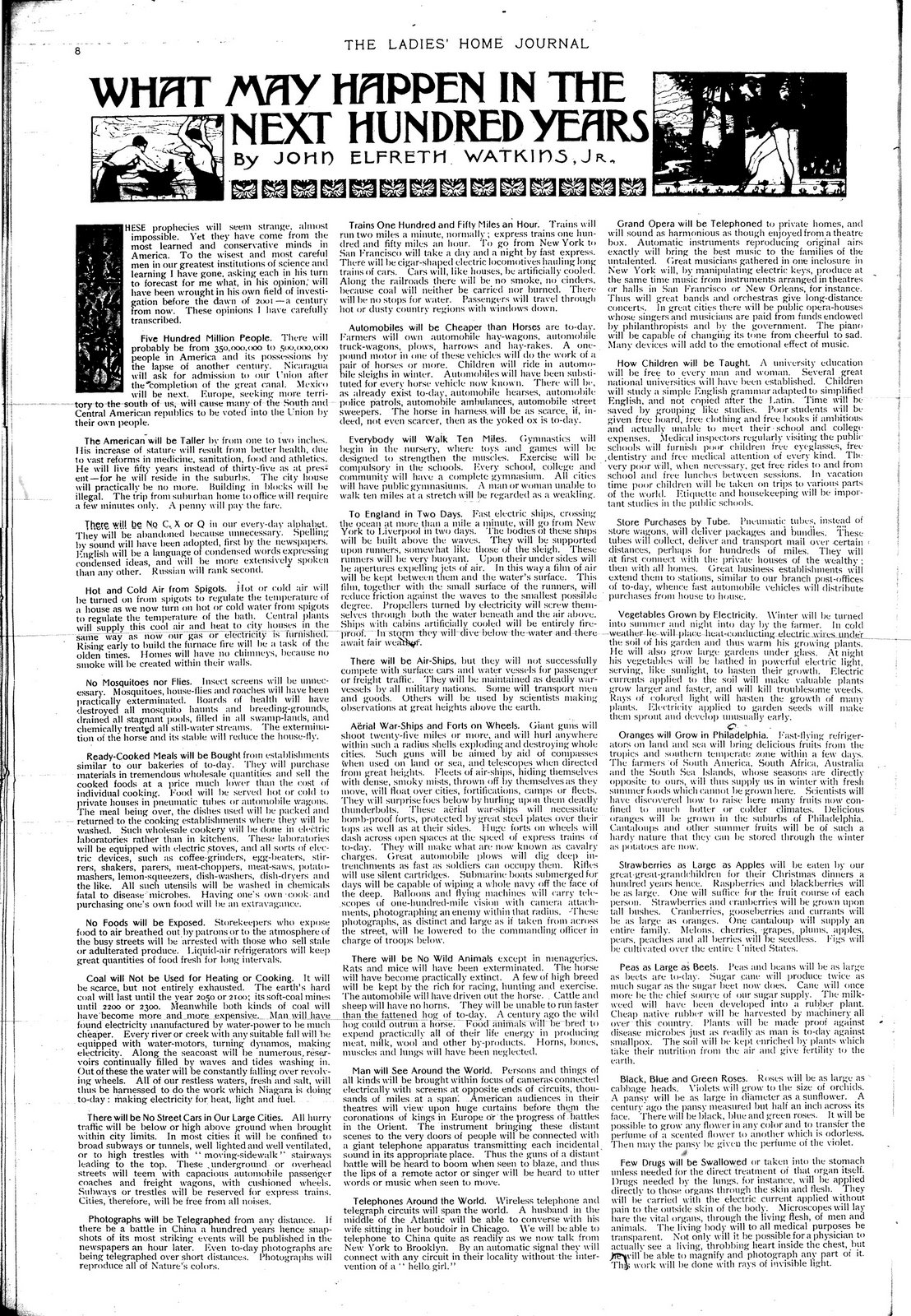
I was intrigued to read an article that was written back in 1900 in a magazine called 'Ladies Home Journal'. The article entitled What may happen in the next hundred years is both startingly accurate, and laughingly off-beam. It predicts for example that by the year 2000, cars will be cheaper than horses. It predicts that by 2000, coal will no longer be used in our houses to heat or cook with. It predicts that there will be aerial warships and forts on wheels. All of these are startlingly accurate if you look at the fact that the motor car has been the preferred mode of transport for families for decades, coal fires and cookers are no longer used in the majority of western homes (although some coal fired power stations remain, there are alternative methods in predominance) and wars have been fought since World War 1 using fighter planes and tanks.


By far the best predictions in the article though, are these: Wireless telephone and telegraph circuits will span the world (Internet?); Photographs will be telegraphed from any distance (Flickr?); And this one: Man will see around the world. The article says: 'American audiences in their theatres will view upon huge curtains before them the coronations of kings in Europe or the progress of battles in the Orient. The instrument bringing these distant scenes to the very doors of people will be connected with a giant telephone apparatus transmitting each incidental sound in its appropriate place.' That's the part that really grabs me. Satellite TV, large screen technology and worldwide television coverage are now taken for granted. In 1900 they were science fiction. If you ignore the archaic language, the article is actually a very accurate set of predictions about future technology. I think it would be difficult to do the same again though, standing in 2010. Technological progress is a lot faster now than it was in 1900, and even predicting what might happen 5 years down the line will be problematic. That's my prediction.


Image source


Creative Commons License

'Seeing the future' by Steve Wheeler is licensed under a Creative Commons Attribution-Non-Commercial-Share Alike 2.0 UK: England & Wales License.
Based on a work at steve-wheeler.blogspot.com.

Saturday, 27 February 2010

Our global village

When I reflect on my recent visit to the Gambia, and on other trips to poor countries, I tend to gain some real perspective on my life. I'm left asking what will the future hold for the Gambian children in this picture? How many will survive to adulthood, have happy lives and achieve their dreams? None for sure, will have any of the opportunities I had when I was their age.

I can't help but feel extremely privileged to come from a part of the world where electricity, water and gas are all piped to my home, and where education is free for all children up to the age of 18.

Even healthcare (we pay our taxes) is free at the point of delivery to all British citizens (and of course to anyone else who is visiting the UK and gets taken ill) courtesy of the National Health Service. Hell, I even have broadband wifi in my house, and enough to feed and clothe my entire family. I'm very, very fortunate indeed. I have always been affected by the following scenario, ever since I first heard it several years ago. If you want some perspective on your life, read on....

If we could reduce the world’s population to a village of precisely 100 people, with all existing human ratios remaining the same, the demographics would look something like this:

Our village would be populated by 60 Asians, 14 Africans, 12 Europeans, 8 Latin Americans, 5 from the USA and Canada, and 1 from the South Pacific


51 would be male, 49 would be female
82 would be non-white; 18 would be white
67 would be non-Christian; 33 would be Christian
80 would live in substandard housing
67 would be unable to read
50 would be malnourished and 1 dying of starvation
33 would be without access to a safe water supply
39 would lack access to improved sanitation
24 would not have any electricity (and of the 76 that do have electricity, most would only use it for light at night.)
7 people would have access to the Internet
1 would have a college education
1 would have HIV
2 would be near birth; 1 near death
5 would control 32% of the entire world’s wealth; all 5 would be US citizens

33 would be receiving (and trying to live on) only 3% of the income of “the village”

Information source

Monday, 25 January 2010

Spinning the Web

This is the final part in my 11 part series on the history and impact of distance education. I have taken a British perspective on this, but of course, other views are available. In this final part, another great Briton makes his impact with a contribution to the World Wide Web.

‘Enquire Within Upon Everything’ was an obscure computer program designed 25 years ago by a young software consultant called Tim Berners-Lee. The program may have been obscure but it was also ground breaking as it encapsulated the ideas that would eventually enable Internet users to link directly from their personal computer to any information they required.

Tim Berners-Lee was born in London in 1955. In 1976 he graduated from Queen's College, Oxford University, before working at CERN, the European nuclear research facility in Switzerland. Whilst working as a computer software consultant, Berners-Lee began to consider the problem of how to communicate and access information via computer on the emerging world wide phenomenon that was known as the Internet. In 1989, Berners-Lee proposed a global hypertext project which he called the World Wide Web. Two years later, his ideas had crystallized on the Internet, and by 1993 the principles of his browser system Mosaic was being championed by the University of Illinois. A year later, in 1994, Berners-Lee joined M.I.T. where he headed up the fledgling W3 Consortium.

The World Wide Web is a truly unique and all pervasive innovation - without it the Internet would not be as successful as it evidently is. Browsers make accessing information ‘friendlier’, and pages more navigable. Berners-Lee has campaigned tirelessly to keep the World Wide Web open and free, and this is possibly one reason why it remains largely an un-policed, imaginatively fertile and unpredictable aspect of distance education. For many commentators, the Internet was inevitable - the World Wide Web simply made it easier for millions to use it.

Image source

Saturday, 14 November 2009

The tribal web

This is the final post in the Digital Tribe series, which is abridged from Chapter 6 of the edited volume Connected Minds, Emerging Cultures (2009).

Anthropologists ascribe a variety of definitions to the word 'tribe' and it can be a contentious term. Most are agreed though, that a tribe is a small society that has its own customs and culture and that these define it. This series has explored the notion of digital tribes and clans, and has applied these concepts to those who consistently inhabit virtual spaces. Such digital territories are ideal environments within which new forms of cultural transmission can propogate and sustain themselves. The tribes and clans I have identified, it could be argued, are emerging as a direct result of their sustained interaction with, and through, social technologies.

Attempting to categorise the behaviour of online users into distinct tribal characteristics can be problematic, because behaviour in virtual worlds (and indeed in the real world) is ultimately diverse and often chaotic or inconsistent. When observed in its entirety however, the trails of evidence emerging on the Web can readily support the notion of the virtual clan. Individuals have an inherent need to belong, so groupings will occur naturally in the real world, in families, kinship groups, clans and other social collectives. The evidence for clannish behaviour online is abundant too, as seen in the creation of specific cultural artefacts that identify distinct web user groupings. The tacit gathering around new 'digital totems' to form transient interest groups is another form of evidence (e.g. Ning, MMORPGS, Crowdvine) as is the marking out of territories through the sharing of social bookmarks, the tagging of digital objects and voting for preferences and usability (e.g. Delicious, Digg). Consistent representation of digital identity within specific tools (recall the Facebooker and Flickrite tribal differences) is yet another form of evidence for the existence of virtual clans.

It should also be acknowledged that clans tend to emerge within tribes as cutural definitions and user generation of digital artefacts become more pronounced. There may be one single digital tribe in the broadest sense of its meaning, but an analysis of the virtual world and it multitude of social networking and communication behaviours indicates that there are indeed many subsets of this large digital tribe - they are the virtual clans, and although we shift our allegiances, we may each belong to several.

Image source

Thursday, 11 June 2009

This generation learning

"Kids are so lucky!" read the tweet. This was in response to a video link I reposted on Twitter today. The title was 'Next Generation Learning' and in the short video, an 11 year-old boy called Harry takes us on a tour of his school. In year 6, he and his classmates use interactive white boards, Wii technology, voting systems and a whole range of ICTs to support and enhance their learning. There are also links so that he and his parents can participate in the life of their school wherever they are, using Internet links and handheld technology. Here's the video:


It's not so far from the truth, and some schools in the UK are already tapping into these tools. I know. I've seen them using them. How long before all schools in the UK and elsewhere in the industrialised world adopt these tools wholesale? What is stopping them? Political issues? Teachers or headteachers reluctant to use them because they are problematic? Economic constraints? Simple fear of the unknown? All of these are reasons some schools stumble in the march forward to new ideas. But I think the most trenchant barrier to grand adoption of emerging technologies is time. Teachers quite simply don't have enough time to do anything other than survive during the working academic year. And then the holidays are spent recovering from the relentless onslaught of planning, teaching and assessment cycles. When the governments of this world stop testing and measuring everything to destruction and start seeing learning as a means to an end rather than as an outcome, then we may see some changes. Then it won't be next generation learning - it will be 'this generation learning'.

OK. End of rant. (Steps down off his soapbox).

Saturday, 15 September 2007

Only here for the fear

An item today on the BBC news web reports that British Telecom is commisioning the men in white coats (read psychologists) to study why some people avoid using the Internet. A quote from the report states: 'Early research done for the project suggests that, for some, using the net is as stressful as a bungee jump'. Well fancy that - how do they know? Let's push this experiment to the limit shall we? Let's get the 'subjects' to use the Internet (on wireless laptops or handheld) whilst doing a bungee jump, and let's get them to gargle with TCP for good measure. Then we can measure real technophobia. To heck with the ethics. (Only joking .... I wouldn't use the TCP).

It will be interesting to see what the men in white coats come up with in their findings, as to whether BT will be pleased about the outcome. I think we already know the answer to that don't we? After all, BT are paying.

Tuesday, 28 August 2007

Cold Turkey?

So I spent (almost) a two week holiday completely OFFline! I admit I suffered the usual withdrawal symptoms though and was tempted on perhaps three or four occasions to go online - the opportunities have been there. You see, I didn’t have internet access in the house I stayed in, but there were several places such as libraries, museums, etc around the region so I could have. I did the same thing last year when we went on holiday to Spain for two weeks – a holiday is a holiday, and I try to avoid anything that resembles work! I admit I do keep my mobile phone with me, but only to take pictures and keep in touch with family.

I heroically resisted the siren's call of the Internet and went cold turkey until the penultimate day of my holiday when I finally succumbed during a visit to Newcastle. I found a computer in a library at the University, logged on and my fears were justified. 268 e-mails were stacked up staring at me, and 197 of them were spam. Blimey. Shouldn’t have bothered. So I had to respond directly to 71 messages when I got home...


Appropriately, I’m reading Distraction by Mark Curtis at the moment. It’s an interesting book, dealing with the pressure we are under today to manage the growing tide of information that continually washes up on our personal shores. Perhaps his most important question in the book is ‘Do we run the risk of believing that data is everything and confusing information with knowledge?’ Curtis believes we have reached the ‘tipping point’ where humankind (at least in the industrialised nations) has no way back in an ‘always connected’ culture. There's an interview with him at this link if you want to know more. The book is not all doom and gloom though, and engages the reader with a number of scenarios in which information and communication technologies can enhance life and create new opportunities for creativity and lively community engagement. He warns though, that the boundaries between public and private spaces are being eroded by digital technologies and we are all being sucked into this vortex. Well, I guess it will be time for me to go cold turkey again in a short while … probably just around Christmas.

Monday, 27 August 2007

Splendid isolation

You know I’m mad keen on visiting places of antiquity, because I have written about it before. Well, here’s another one for you – this is me visiting a medieval site called the 'Hermitage', just down the river from Warkworth Castle, in Northumberland (picture left courtesy of my 13 year old niece Sarah) during what we laughingly call our British 'summer'. The Castle was great and well worth a visit, and as you would expect, the ‘Hermitage’ is quite isolated and can only be reached by a ferry over the river. Apparently, it was the home for many years of a hermit who lived in austere conditions, isolated from the community. It certainly is a bleak and unwelcoming place. I hope he had some kind of heating, ‘cos I reckon in the middle of a Northumberland winter it would be cold enough to freeze the balls off a brass monkey. Inside there are three small rooms carved out of the living rock -there is a chapel, a long thin (bed)room, and a ledge (open to the elements) that looks out over the woods. There is no fireplace, no electricity, no running water (apart from the river), and certainly no broadband internet connection. There wasn’t even a Welcome doormat. Modern city dwellers would find it very uncomfortable – it felt very lonely and isolated there so I didn’t stick around for long, and I’m sure I wouldn’t want to still be there come nightfall….

Got me thinking about how much we rely on modern technology to make ourselves comfortable. Where would we be without gas cookers, electric light bulbs, flush toilets, washing machines and all the other basic stuff we take for granted? What about the more luxurious stuff like televisions, iPods, mobile telephones, microwaves and home computers? Now we have the uber-luxury technologies – multi-viewer digital cable television, flat screen plasma TVs, global positioning satellite systems, etc etc ad nauseum … you get the idea. Here’s the question – how long before we get so hooked on these new technologies that they become essential for our psychological well-being and comfort? I don’t think I could be a technological hermit – using such items is too deeply ingrained into my personal culture and it would feel like an amputation to give them up. How sad is that? In tomorrow’s next blog I'm continuing this train of thought....

Tuesday, 17 July 2007

Keen as mustard?

I'm back safely on British soil again, courtesy of British Airways, who always get you there in the end... I'm worried about National Express though. They seem to be incapable of joined-up-thinking. They got me from Gatwick to Heathrow OK, but then I sat waiting for an eternity at Heathrow central bus station for the 500 service to Plymouth. It was delayed by over two hours due to 'traffic congestion' in London. (So much for Ken Livingston's congestion charge, which makes craploads of money for the council, and no improvement in traffic flow). The bus behind it actually arrived first and there was pandemonium as both sets of passengers tried to board simultaneously. The driver had to fight them off with his clipboard, and he might even have used a rude word, but I can't be certain as someone's elbow was in my ear.

Eventually, my bus set off amidst squally showers and very un-July weather. Such a constrast from the 37 degrees I left behind in Heraklion. What a summer - British weather is not good for the soul. We stopped for a 15 minute break at the Gordano service station just outside Bristol. Would you believe it... inside they were playing Cliff Richard singing 'O Little Town of Bethlehem!' No, I am not making it up - but I thought, how very appropriate, given the wintry torrents of rain outside.

I am in the middle of reading Andrew Keen's The Cult of the Amateur - in which he pours mustard all over Web 2.0, and suggests that it's a conspiracy to destroy our culture and assault our economy. Well I never... Keen seems more concerned about making sure that shareholders don't lose their money than he is about democracy, where everyone has equal access to the Internet as readers and writers. Keen is of course a share holder himself and a prominent capitalist. He's a few index points short of a dividend too if you ask me. He admits to trying to cash in on the Internet boom of the 90s, so how very appropriate for him to talk about bloggers behaving like monkeys with typewriters. It's the same as playing Christmas carols in the middle of summer... but not half as amusing. Check out Andrew Keen's own blog (well fancy that) and you'll see what I mean.

Friday, 1 June 2007

YZ on young shoulders....

It's been an interesting and busy week teaching here at the Technical University of Liberec, in the northern Czech Republic. Everything is different here to the UK including, mercifully, the weather (a balmy 28 degrees today). I need to be particularly careful with the keyboard I am using as it has transposed 'y' and 'z' keys. Cognitive load is more excessive than usual....

I have just finished a week teaching 20 German, Czech, Polish, and for the first time, Nigerian students. They are all very young and very enthusiastic and have been asking lots of questions, which makes my job easier, and paradoxically, harder. We have studied the psychology of interpersonal communication, with a section on Internet communication. I created a wiki for them on the spot, which you can visit at
this link. It will be interesting to see if there are any cultural variations in the postings and discussions that take place.

Next week I'm back in dear old blighty, and then off to Napoli, Italy to present a paper at the
EDEN conference. More later - now I'm off to let my hair down a little, before I catch my flight... Nashledanou....

Thursday, 1 March 2007

Protect the children ..... and the teachers

The magazine Wired News carried a sad and rather disconcerting tale last week. I have just been too busy until now to post it, but I have discussed it with my students and they are more disturbed by it than they were on the day I gave them their asignment task. It appears that a teacher in an American high school - substitute teacher Julie Amero of Norwich, Connecticut - has this week been sentenced to 40 years in a state penitentiary. Her crime? She is accused of showing Internet pornography to the 12-13 year old children in her class.

Shock horrors! I hear you cry - lock her up and throw away the key!!

But hold on - let's not be so hasty. Before you make your mind up, here's a
further account of her 'crime'. She claims -- and all the evidence proves -- that the school computer got hit with a pop-up frenzy she didn't know how to stop. The report goes on to detail the following information: 'The IT department failed to keep content filters and anti-malware software up-to-date. The school failed to enforce a security policy, allowing substitute teachers to use regular teachers' network credentials to access the internet. The administration failed to ensure that all teachers, including substitutes, had the necessary skills and training to handle internet surprises -- and the savvy to respond quickly in a crisis'. (Wired, February 23, 2007)

Whilst you and I both know that protecting the growing minds of the children in our care is paramount, and whether or not the teacher is guilty, this case raises some key questions: I feel particularly uneasy about the vulnerability of teachers who venture onto the web during lessons. Certainly all teachers should pre-visit the sites they want to show children before the children are present, and 'filter' out the bad stuff. But this doesn't protect them from 'pop-up' frenzies, particularly if the school isn't interested in investing in software and training to ensure this kind of event doesn't happen. What is the responsibility of the employer (the school) in all this? Will the school also be prosecuted? I think we should be told....

Wednesday, 3 January 2007

Living in a post-modem world

Blimey. Talk about digital divides... yesterday the BBC [BBC News 24, 2 January 2007] reported that by the end of this month 13 million households in the UK will be connected to broadband. That's half the households in Britain for Tim's sake. It's all because there are over 200 broadband providers in the UK, all fighting for an ever dwindling population of customers, and all being so competitive that by the end of 2007 half of them will be dead in the water.

Got me thinking... if half of all UK households can now access high speed Internet what can we expect?
  • Firstly, more people will be watching video and other megabyte hungry media on their pcs - does this mean the death of terrestrial broadcasting? Will YouTube replace Channel 4?
  • Secondly, more people will pay to download music from the Internet and less will be going into town to buy CDs. Is the end of HMV and Virgin Records in sight?
  • Thirdly, more people will be shopping on Amazon, E-Bay and other online retailers than before. Get your food delivered direct to your doorstep by Tesco or Sainsbury! (It's a shame we can't get our rubbish collected from our doorstep by the local council. They haven't been around for almost 2 weeks over the Christmas break and the wheelie bins are disgusting).

Yesterday Rupert Goodwins of ZDNet UK was interviewed by BBC News. He remarked that 'the Internet is non-geographical' (as he sat firmly on a seat in the Edinburgh studio). I think I know what he means, but then he went too far with 'everyone is now online'. I don't think so. My Mum and Dad are steadfastly non-Internet and so is my rabbit Charlie (although I am thinking of breaching privacy rules and placing a webcam in his hutch), and I reckon there are one or two others in the UK who are just not interested :-P. So we still have a digital divide and it's not just those who have and don't have broadband. It's also those who couldn't care less about the Web.