 The city of Warsaw has a reputation for being a beautiful place, and indeed it is, but the part of town I am staying in seems stern and forbidding. Some of the architecture is a stark remnant of the Soviet era, and the ghost of Uncle Joe seems to leer at you from the solid buildings, and from across the vast, open squares (Yeah, I know, hit the link for Uncle Joe - and it's one big joke...I just couldn't resist). I hate to think what it's like here when the bitter cold north winds bite down from the Baltic in the winter. Warsaw has more than its fair share of large, square edifices which glower down at you like stone sentinels, and I can imagine them during communist times daring you to mutter a word against your totalitarian masters. It must have been bleak here during the Cold War, and even now, with Poland a recent addition to the European Union family, there are parts that still feel a little cold.
  I have to walk past the American and Canadian embassies twice each day, and the queues of hopeful locals waiting to secure visas, attests to the fact that some people want to get out. I am staying in student accommodation and the entire place looks very tired and worn-out. It’s very similar to my experiences staying in Czech accommodation. Touch something and it either comes off in your hand or just doesn’t work. The bedside lamp doesn’t come on. The TV is on the fritz. The curtains hang away from the rails. I suppose I am spoiled. Last week’s Lisbon hotel (The Holiday Inn Continental) was absolutely superb, and the staff fell over themselves to make you feel at home. The people are very friendly here when you get to know them though, and I have enjoyed talking to folk over lunch and dinner about their research into electronic delivery. There are also a large selection of bistros, cafes and bars to hang out in if you care to walk a little distance down toward the old town (Stare Miasto) and into the chic boulevards such as Novy Swiat where you can enjoy a coffee and talk to the locals.
 Stare Miasto (picture of the old town square left) is another matter altogether. It is poles apart from where my lodgings are, and is charming, mysterious and magical all at one time. The pictures accompanying this post give you a sample of some of the wonderful buildings in that 'old part' of Warsaw. Interestingly many of them were rebuilt faithfully in the 1950s from old photographs, because unfortunately, the whole place was bombed flat during the war. Streuth, but they did a good job. You can hardly see the joins and the scotch tape is well hidden.
 There is currently an outdoor exhibition of 136 huge United Buddy Bears – glass fibre 3-D canvases in the shape of bears, one representing each of the countries recognised by the United Nations. (How do you recognise a country...? Oh, there’s Germany over there. I can see the sausages hanging out). They are on a world tour in the cause of world peace and have so far raised over 1.2 million dollars for the UNESCO Save the Children fund.
 I have met one or two familiar faces at this conference.... Anna Grabowska (University of Gdansk), whom I met up with and blogged at last week’s EDEN conference is here. So also is Kzrysztof Amborski (Warsaw Polytechnic), who I had the pleasure of working with in Ireland in February. He and I have roles in the Atlantis University project which is organised by Fachhochschule Darmstadt, to be research mentors for Masters and PhD students in computer science and e-learning. I'm home in a few days, and onto my next engagement speaking at Bath University. I will actually return to Poland, but not until next June for the next EDEN conference which will be held in Gdansk.
 ‘Successful Virtual Universities: Some Key Issues’ was the title of the second keynote of the morning given by Albert Sangra who is at the Open University of Catalonia, in Spain. Albert talked about the experiences gained at his university, which is fully online and therefore ‘virtual’. Albert’s main concern was that teaching and learning is not about technology, but about whether we can develop new approaches to delivery, which involve technology. Better to start separately and then merge methods and technologies once the needs have been identified.
There are four main reasons whay universities try to use online education, said Albert:· To increase access to education
· To improve university economic expectations
· To respond to the technological imperative
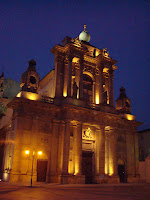
· To improve quality of educationThe second reason he said, is sometimes a mistake, because online education is often more expensive than face to face education. E-learning is an evolution of the use of technology in education, from the humble correspondence course, through telephone, CD ROM and now of course, the Internet. Use of any new technology inevitably promotes changes in universities. It involves redefining roles, administration processes, teaching methods, restructuring educational design and ultimately, changing the university itself, he said. Technology, organisation and pedagogy are the three key areas of change, and should not be thought about separately. The OUC has adapted delivery through ICT to the needs and profiles of their students, who are predominantly mature and working people. Delivery is fully asynchronous at OUC, and there is a division of labour between course developers, advisors, (showing an emphasis on student support) and administrators. OUC is certainly very successful, so this is a tried and tested model of distance education.Above is another picture taken last night in the old town area of Warsaw.
 We are in the second day here at the Polish Virtual Universities Conference in Warsaw. Ronan Chabauty (FIED – Federation Interuniversitaire d’Enseignment a Distance: A French Distance Teaching Organisation) talked about France’s national conceptualisation of distance education, which is the one the French Education ministry has approved for funding. His keynote involved discussion of the old quadrant model of ‘same time, different place, etc’. He espouses two classic typologies, one of which is the competence model of enriched learning through technology, whilst the other takes a location dependent position of ‘reduced face to face’ and ‘quasi non-existent face to face’. I'm not sure what he meant by this, as there was no time for elaboration. However, I think this essentially means that distance teaching for the French is an alternative means to face to face and as Ronan said, 'has to be distinguishable from face to face teaching'. A little 'old school' I thought and perhaps not acknowledging some of the new technologies that are reducing conceptions of what distance actually is. I had to get up on my hind legs and I ask him what his position was then, on the blended approaches that are so prevalent in the UK? He replied that students who are away from the campus receive the 'enriched learning through technology' delivery - not so much a distinction then, as an alternative method of delivery. Students are changing and we need to change our delivery methods, he said, which first involves changing the minds of colleagues. A perennial problem which I think affects all institutions.Ronan concluded his talk by saying that in France (and also most other places) there is still a great amount of work to do to ensure that anyone and everyone can study from wherever they are located and therefore participate fully in lifelong learning. Oh, and by the way, the photo above is one I took last night as the sun was setting on the old Stare Miesto (old city) of Warsaw.
 It’s the first day of the Polish Virtual Universities conference here in Warsaw and I must admit I’m feeling a little lost. I opened the conference with the first keynote of this three day event, and then it was all downhill from there in. The audience was disturbingly quiet, but I’m told that this is the way they listen to speakers. They applauded heartily at the end of my speech, but no-one dared to ask a question. It’s a different culture, a different reaction, so get over it Steve.
There are 140 delegates registered for the conference and 136 of them are Polish. So naturally the entire conference is also in Polish, and I don’t understand a word of it of course. At other conferences there is usually an interpreter, but I am the only Brit here, so I shouldn’t expect anything else should I? OK, there are also a couple of other keynote speakers from France (Ronan Chabauty) and Spain (Albert Sangra) and they will also present in English, but apart from that, nada. There are over 70 papers and posters due to be presented here, and also 8 keynotes. I have managed to decipher some of the paper headings, which include podcasting, blended learning, e-portfolios, wikis, 3-D storytelling, Second Life, and several others have Web 2.0 in their title.
Oh how I wish I could hear them, or at least be able to read them in English.
 The EDEN conference is coming to an end and with one more day to go, it is almost time to reflect on the event. I will do so in more detail when all the usual detritus of winding down from a conference ... the hotel check out, travel home and unpacking etc ... have been dealt with. I will be home for only one day before flying out again on Tuesday for my next engagement as keynote speaker at the Polish Virtual Universities Conference in Warsaw. I have already spoken to Albert Sangra (Universidade Oberta Catalunya) who is the other keynote speaker for the event. He is also here at EDEN.
The EDEN conference blog is a great success with a growing repository of comments, posts, pictures and hyperlinks in its pages. Do have a look and comment when you have time. It is another day here in Paradise, with the sun shining and the purple blossom of the Jacaranda trees sharply contrasting with the red and yellow of the older buildings in Lisbon. It has been quite an experience here, and has lived up to every expectation I held about the place. I would like to thank the organisers of EDEN this year for their attention to detail. Apart from the unreliability of the wireless network (which everyone seems to be complaining about) there are no grumbles. Only good memories, excellent contacts with people doing real research, and a sense of satisfaction.
 I have to walk past the American and Canadian embassies twice each day, and the queues of hopeful locals waiting to secure visas, attests to the fact that some people want to get out. I am staying in student accommodation and the entire place looks very tired and worn-out. It’s very similar to my experiences staying in Czech accommodation. Touch something and it either comes off in your hand or just doesn’t work. The bedside lamp doesn’t come on. The TV is on the fritz. The curtains hang away from the rails. I suppose I am spoiled. Last week’s Lisbon hotel (The Holiday Inn Continental) was absolutely superb, and the staff fell over themselves to make you feel at home.
  Stare Miasto (picture of the old town square left) is another matter altogether. It is poles apart from where my lodgings are, and is charming, mysterious and magical all at one time. The pictures accompanying this post give you a sample of some of the wonderful buildings in that 'old part' of Warsaw. Interestingly many of them were rebuilt faithfully in the 1950s from old photographs, because unfortunately, the whole place was bombed flat during the war. Streuth, but they did a good job. You can hardly see the joins and the scotch tape is well hidden.
 There is currently an outdoor exhibition of 136 huge United Buddy Bears – glass fibre 3-D canvases in the shape of bears, one representing each of the countries recognised by the United Nations. (How do you recognise a country...? Oh, there’s Germany over there. I can see the sausages hanging out). They are on a world tour in the cause of world peace and have so far raised over 1.2 million dollars for the UNESCO Save the Children fund.


